A confidence interval is a range estimated by a statistical procedure to express uncertainty around a measured population quantity. In RAG evaluation, it turns a bare score such as faithfulness = 0.82 into an estimate such as 0.82 ± 0.03 at 95% confidence. section 14.3.2
Confidence intervals support more reliable evaluation by:
- Combining predictions on a large unlabeled dataset with approximately 150 human annotations to correct an automated judge through prediction-powered inference. section 14.3.2
- Using bootstrap resampling and multiple evaluation samples to represent randomness in LLM-generated scores. section 14.3.3
- Separating meaningful regressions from evaluation noise instead of treating one observed score as a definitive measurement. section 14.7
- Grouping resampling by the source of generated questions when several questions derive from one passage, because those observations are not independent. section 14.7
Repeated evaluation of a RAG answer
A fabricated answer may receive faithfulness 0.00, answer relevance 0.83, and context relevance 0.75. Repeating the evaluation can change context relevance from 0.75 to 1.00, showing why an interval is needed before interpreting a dashboard difference. section 14.2.4
Figure 14.4 The ARES three-stage evaluation pipeline.
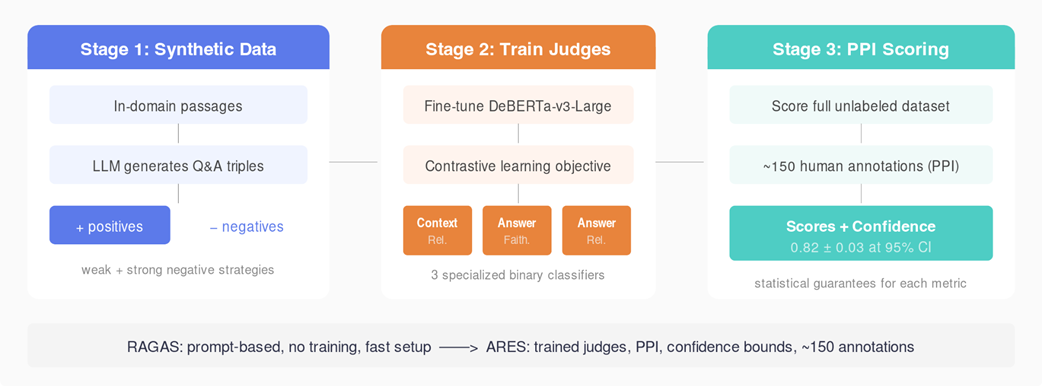
The ARES pipeline shows how synthetic data, lightweight trained judges, human validation, and prediction-powered inference combine into statistically bounded RAG measurements. section 14.3.2











