liveBook · Manning

Decision tree

As explained in Applied Reinforcement Learning

A decision tree is a tree-shaped model in which internal nodes represent tests or decisions and leaf nodes represent outcomes.

A decision tree maps choices and consequences as branches: internal nodes hold tests or decisions, and leaves hold outcomes. For example, a demand test might lead to a promotion decision. section 7.1

In route planning, a tree can start at a depot and branch into route and delivery-order choices, with costs recorded at each node. section 7.1

Figure 7.1 Tree data structure in vehicle route planning problem
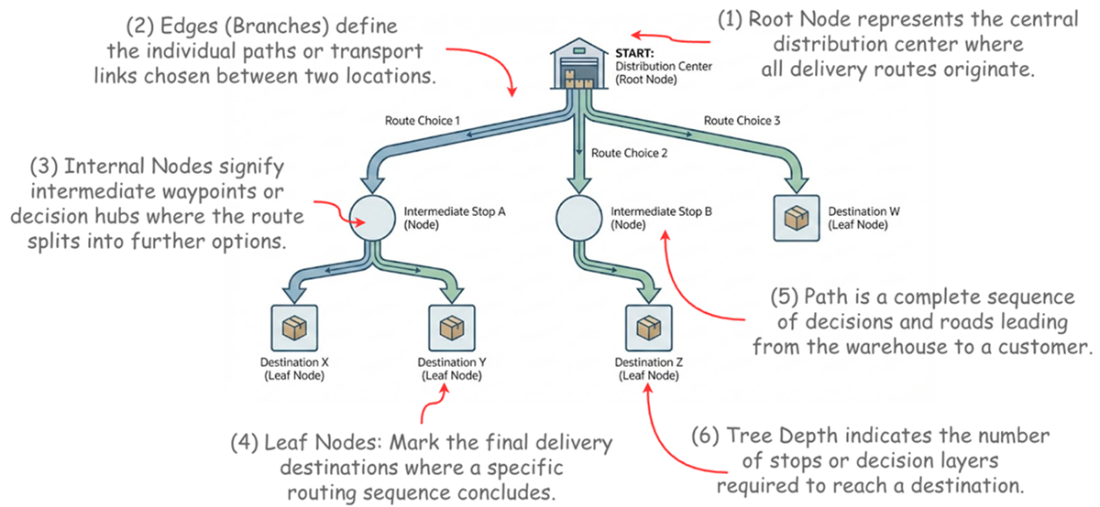
See a route-planning tree branching from a depot into route choices. section 7.1


How Applied Reinforcement Learning covers it

How deep it goes
Defines decision nodes and outcomes, then sketches routing branches and costs without developing a decision-tree learning algorithm.
Examples
Uses a demand threshold leading to a promotion outcome and a depot branching into delivery routes.
What you can do after
Understand how a tree represents decisions, branches, and outcomes in a business or routing scenario.
How it connects
Connects decision trees with tree data structures, game trees, business analytics, and Monte Carlo tree search.

Also explained in

Compare how 18 books explain decision tree →

Related concepts

This explainer was generated by Manning's knowledge graph from the text of Applied Reinforcement Learning. The section links point to the parts of the book it draws on.















