Software migration moves an application to a different stack or implementation while preserving required behavior. A legacy codebase may hide crucial knowledge in its code, and a one-shot AI rewrite can produce a change too large to review reliably. Use AI to uncover architecture and propose changes, but verify each increment before moving on. section 2.0 section 2.5
A disciplined migration proceeds in reviewable steps:
- Map the existing layers, dependencies, and features that must survive. Use code analysis to recover implicit knowledge, and use static-code tools where they are better suited than an LLM. section 2.0 section 2.2.1
- Choose an in-place migration or a new repository. In-place work preserves history and comparison, but can mix configurations; a new repository offers separation at the cost of copying code and losing history. section 2.3
- Scope each change large enough to justify automation but small enough for human review and testing. A request for a minimal set of changes can limit over-engineering, though related components may still need to change together. section 2.5 section 2.5.1
- Run tests and inspect the actual changes before declaring a step complete. A missed legacy import in a test can block dependency cleanup and undermine another team's assumptions about progress. section 2.4.3 section 2.7
- Commit isolated steps and involve engineers familiar with the legacy system in review. For larger projects, separate pull requests by step or layer to keep each review manageable. section 2.11
Figure 2.4 Change-set size vs the AI Payoff during the application migration. The higher the magnitude of change, the higher the review risk.
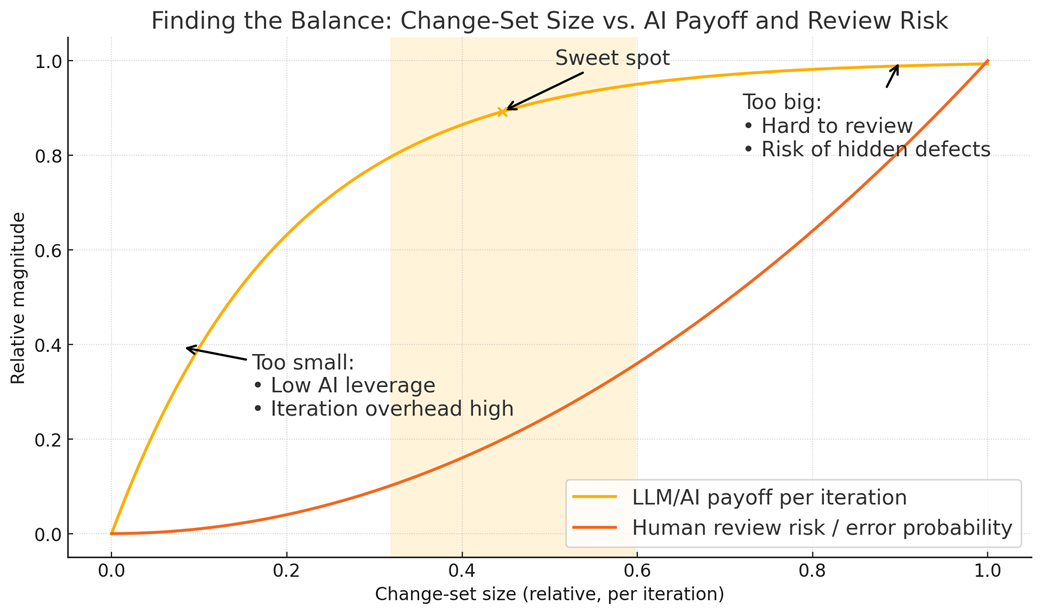
The change-set size diagram contrasts the payoff of AI assistance with the increasing risk of human review. section 2.5
JBoss to Spring Boot
A migration of a member-management application maps its REST, business, persistence, and UI layers before replacing JBoss and Jakarta components with Spring Boot. A minimal-change prompt also touches persistence and event publishing because they are connected to the REST layer. UI testing may need additional tests or manual checks when coverage is weak. section 2.1 section 2.5.1 section 2.7
Code migration is not the same as moving customer data. Changing persistence code to use a new database leaves the runtime problem of transferring existing data without loss or corruption as separate work. Between AI-assisted steps, clear stale conversational context while retaining project constraints and architectural rules. section 2.10 section 2.7
At fleet scale, dependency migrations can use an agent to branch, change code, and run affected tests. Automatic merging is limited to changes that pass tests and fall below a complexity threshold; other changes receive human review. A dependency graph helps sequence upgrades across consumers. section 10.6.1






















