Architecture is tested after approval, when delivery pressure, operational needs, changing requirements, and organizational constraints expose the limits of earlier assumptions. Feedback is the information supplied by those consequences: evidence that a decision still fits its context, or that it must be reconsidered. It makes architecture a continuing loop of intent, forces, decisions, consequences, and adaptation rather than a one-time design event. section 1.0 section 1.8
Feedback does not prescribe a single ideal design. It tests whether a design remains good enough: correct, secure, operable, understandable, recoverable, and viable within time, cost, skills, ownership, and risk constraints. A decision remains valid only while feedback from reality confirms the conditions on which it depended. When conditions shift, the aim is neither reflexive redesign nor stubborn adherence, but deliberate correction. section 3.2 section 4.0
Use feedback to govern architectural commitment:
- Stabilize decisions that are costly to reverse, while keeping uncertain decisions cheap to change until evidence improves. section 3.3
- Define revisit triggers so assumptions about availability, release frequency, compliance, ownership, or coupling can be tested explicitly. section 3.3
- Bring feedback forward through early delivery slices; delayed validation makes reversal more expensive. section 3.3
- Treat incidents, operational pain, failed assumptions, migrations, and scaling surprises as signals about boundaries, ownership, and risk. section 4.8 section 4.9
Reviewing an uncertain decision
A lightweight decision log distinguishes what must be decided now from what should remain open. Deployment shape, repository organization, and coarse data ownership may need early attention because later changes affect pipelines, infrastructure, support procedures, integrations, and team boundaries. Other choices can wait until requirements, usage, and ownership are clearer. Revisit triggers turn later feedback into a reasoned decision point rather than an unstructured debate. section 3.3
Figure 3.3 Designing for the ideal end state often delays first value and pushes feedback later, when reversal is more expensive. A good-enough and evolvable approach delivers an early slice, uses feedback sooner, and strengthens the architecture as evidence improves.
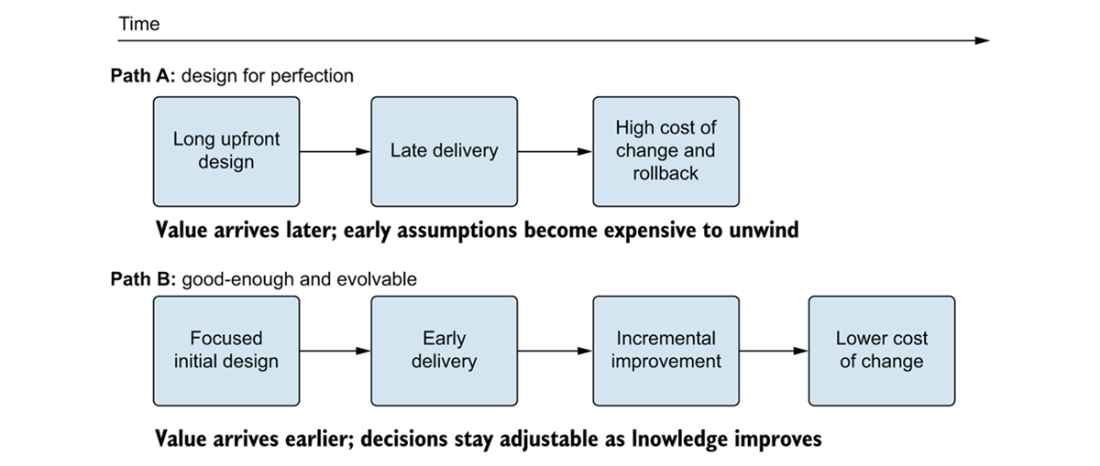
An early slice shortens the path from assumptions to evidence, allowing the architecture to strengthen where value and need become clear. section 3.3
Feedback loops also depend on collaboration. Decisions must be reviewable rather than personal; their assumptions, trade-offs, and evidence should be visible. Candid feedback, psychological safety, mentoring, and safe ways to raise concerns let teams notice painful boundaries or permanent workarounds before a rewrite is the only option. Leadership affects whether this evidence can lead to change by setting direction, investment, ownership, and delivery pressure. section 4.8 section 4.9
The practical heuristic is to ask: what evidence would show this choice is no longer appropriate, when will it appear, and can the team act before change becomes prohibitively expensive? Feedback supports judgment by making trade-offs visible, reducing the cost of mistakes, and preserving the ability to adapt safely. section 3.2 section 4.9