Kullback–Leibler (KL) divergence measures how different one probability distribution is from another. Like Euclidean distance compares points, KL divergence compares distributions. It is nonnegative and equals zero when the distributions match exactly. section 12.2.1
Figure 12.7 Euclidean distance measures the distance between two points on a plane, while the KL divergence measures the distance between two probability distributions.
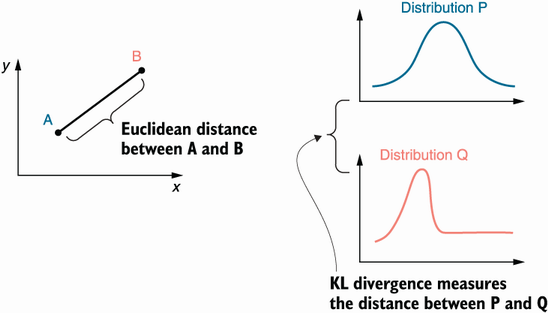
Use the geometric analogy to contrast ordinary distance between points with divergence between probability distributions. section 12.2.1
In a variational Gaussian process, KL divergence measures the difference between the posterior conditioned on inducing points and the posterior conditioned on the full dataset. Minimizing that difference makes the approximate model resemble the full model. Direct optimization uses the evidence lower bound (ELBO) as a computable proxy for the true loss and marginal log likelihood. section 12.2.1 section 12.5











