liveBook · Manning

Kullback–Leibler divergence

As explained in Optimization Algorithms: AI techniques for design, planning, and control problems

Kullback–Leibler divergence is a metric quantifying the dissimilarity between two probability distributions.

Kullback–Leibler divergence, or relative entropy, measures the dissimilarity between probability distributions P and Q. It is defined as KL(P || Q) = ∫ P(x) · log(P(x) / Q(x)) dx across the variable’s support. section 12.1.5

In PPO-penalty, KL divergence penalizes updates that move a policy too far from its previous version, supporting a manageable trust region and reducing large policy shifts. section 12.1.5

Comparing Gaussian policies

A comparison between two Gaussian distributions with different means and variances illustrates the divergence. KL divergence equals zero exactly when the two distributions are identical. section 12.1.5

KL divergence between two Gaussian distributions
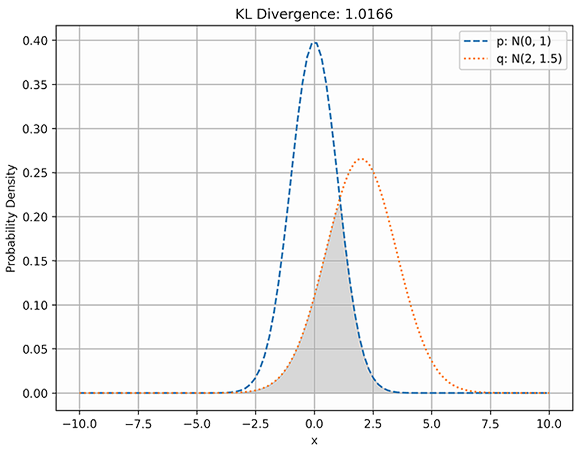
Inspect the figure comparing KL divergence between two Gaussian distributions. section 12.1.5


How Optimization Algorithms: AI techniques for design, planning, and control problems covers it

How deep it goes
Defines the integral and zero condition, but stops short of deriving the measure or detailing numerical computation.
Examples
Uses Gaussian distributions with different means and variances as a visual comparison.
What it assumes
Assumes familiarity with probability distributions, probability density functions, and policy updates.
What you can do after
Evaluate how far an updated policy departs from an earlier policy within PPO-style optimization.
How it connects
Connects probability distributions, PPO, policy updates, trust regions, and TRPO.

Also explained in

Compare how 12 books explain Kullback–Leibler divergence →

Related concepts

This explainer was generated by Manning's knowledge graph from the text of Optimization Algorithms: AI techniques for design, planning, and control problems. The section links point to the parts of the book it draws on.









