Kubernetes raises the abstraction level above infrastructure and containers, providing a foundation for platforms that application developers can consume through APIs. That abstraction can reduce direct exposure to cloud and Kubernetes details, but an expanding ecosystem of related tools can also increase cognitive load when developers must manage low-level concerns themselves. section 1.1.2
In development, Kubernetes is useful when the target system is distributed and production behavior matters to application design. Containers and Kubernetes establish shared interfaces and behaviors between development and production, helping teams reason about topology, networking, scaling, resource connections, and how an application will run after deployment. section 3.1.1
Bringing Kubernetes into the inner loop can help teams:
- Make more informed architectural and design decisions by understanding the target runtime environment. section 3.1.1
- Reduce damaging differences between development and production environments without claiming that those differences disappear entirely. section 3.1.1
- Create a common language for application and operations teams, improving feedback about how applications run in production. section 3.1.1
- Shift Kubernetes closer to developers while weighing the benefits and drawbacks of that choice. section 3.0
A local cluster is a practical starting point for the inner loop. Keeping the complete development environment on a local machine supports offline work, gives developers control over the environment, and can speed feedback. The cluster may be provisioned inside an application-specific environment or separately on the host so multiple local application environments can share it. section 3.3.1
Shared local cluster with kind
For a distributed system developed across multiple application environments, provision one local cluster as a shared host resource rather than embedding a separate cluster in every application environment. Use kind to run a lightweight Kubernetes cluster as containers, then verify the active context and node readiness with kubectl. Per-application clusters remain useful for workshops, training, or experiments. section 3.3.1
Figure 3.1 Containers and Kubernetes as the shared language between development and production environments
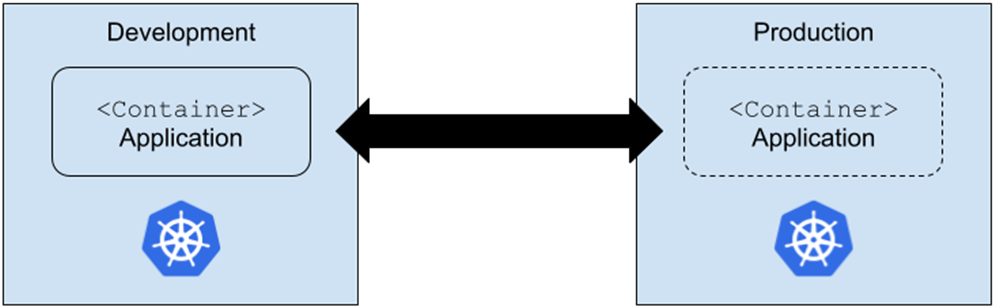
This diagram shows containers and Kubernetes serving as the shared language between development and production environments. section 3.1.1
Figure 3.9 A Kubernetes cluster can either be provisioned inside each development environment or on the host machine so that it can be shared. Which option to choose depends on the use case.
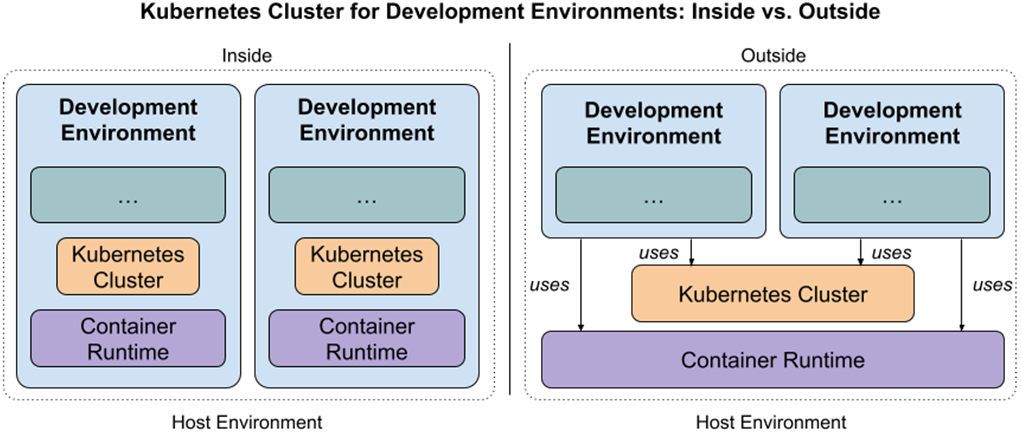
This comparison helps choose between an isolated cluster per development environment and a cluster shared from the host machine. section 3.3.1
Kubernetes should support developer flow rather than become an undirected infrastructure burden. Platforms built on Kubernetes can expose on-demand services while concealing internal infrastructure complexity, preserving separation of concerns between application work and platform implementation. section 1.1.2






















