Application architecture structures how an enterprise action is represented and controlled. When an agent can invoke an existing capability, a technically valid request is not enough: the architecture must also make the permitted action, review, preserved state, and recovery path clear. section 1.5.1 section 6.0
Application and integration architecture meet at the system boundary. Application architecture governs the action and its state; integration architecture governs what crosses the boundary, under whose authority, and with what validation, evidence, and compensation. Both must keep the intended business effect aligned with the instruction and executed transaction. section 6.0
For an agent-facing application capability, make the decision boundary explicit:
- Define what the agent may request and when human sign-off is required. section 1.5.1
- Specify the confirmation the interface expects and its response to an out-of-bounds request. section 1.5.1
- Preserve the state and evidence needed for review, and design a recovery path if the action is wrong. section 6.0
- Use runtime controls, such as circuit breakers, to constrain or halt autonomous behavior. section 1.5.1
Freezing compromised accounts
A fraud agent calls a core-ledger API originally designed for human-initiated transactions with a second reviewer. Safe invocation requires an explicit limit on how many accounts the agent may freeze, human sign-off above that limit, and an API contract for requests outside agreed bounds. A circuit breaker can stop a cascade if a poisoned threat-intelligence feed triggers widespread freezes. section 1.5.1
Figure 1.5 Autonomy across architectural layers, showing how each layer acquires a runtime governance dimension without replacing existing structures.
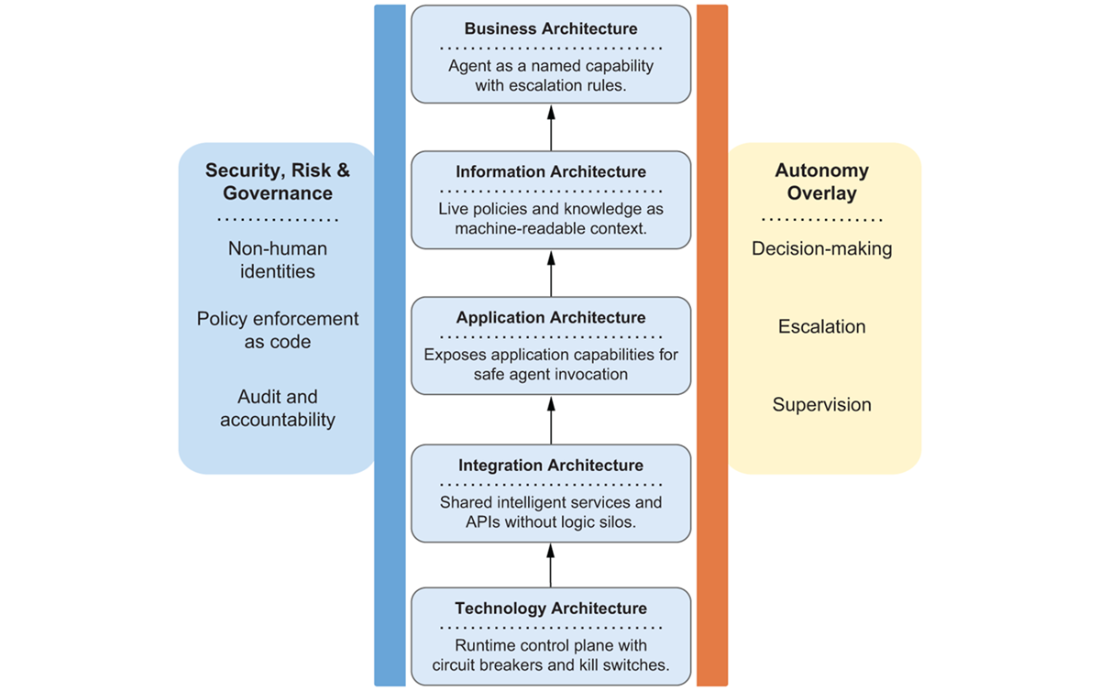
See how application architecture gains a runtime governance role alongside the other architectural layers. section 1.5.1





















