Model architecture is the arrangement of layers and neurons that determines how a neural network transforms inputs into predictions. It specifies the network’s computational structure, including its depth, width, connectivity, and layer roles. section 8.2.1
A basic feedforward architecture contains:
- An input layer with one node for each input. section 8.2.1
- One or more hidden layers containing artificial neurons. section 8.2.1
- An output layer representing the network’s prediction. section 8.2.1
- Connections that pass each layer’s output forward as the next layer’s input. section 8.2.1
Depth counts hidden layers; width counts neurons in a layer. Dense layers connect every neuron to every neuron in the preceding layer. Activation functions add the non-linear transformations needed to model complex relationships. section 8.2.1
During a forward pass, inputs move through successive layers to produce an output. Larger architectures can learn more complex functions, but they also increase computational cost and overfitting risk. section 8.2.1
Architecture in a compound-screening workflow
A PyTorch workflow converts compound inputs into tensors, specifies a model architecture, fits it to data, and evaluates predictions on test data. The resulting model can score compounds so likely active compounds appear near the top of a ranked list. section 8.3
Figure 8.10 A neural network can be composed of artificial neurons across an arbitrary number of hidden layers (i.e., network depth) and number of neurons per layer (i.e., network width). Each neuron can be decomposed into a computational graph similar to what we visualized in previous figures, which we then chain to form the larger, more complex network.
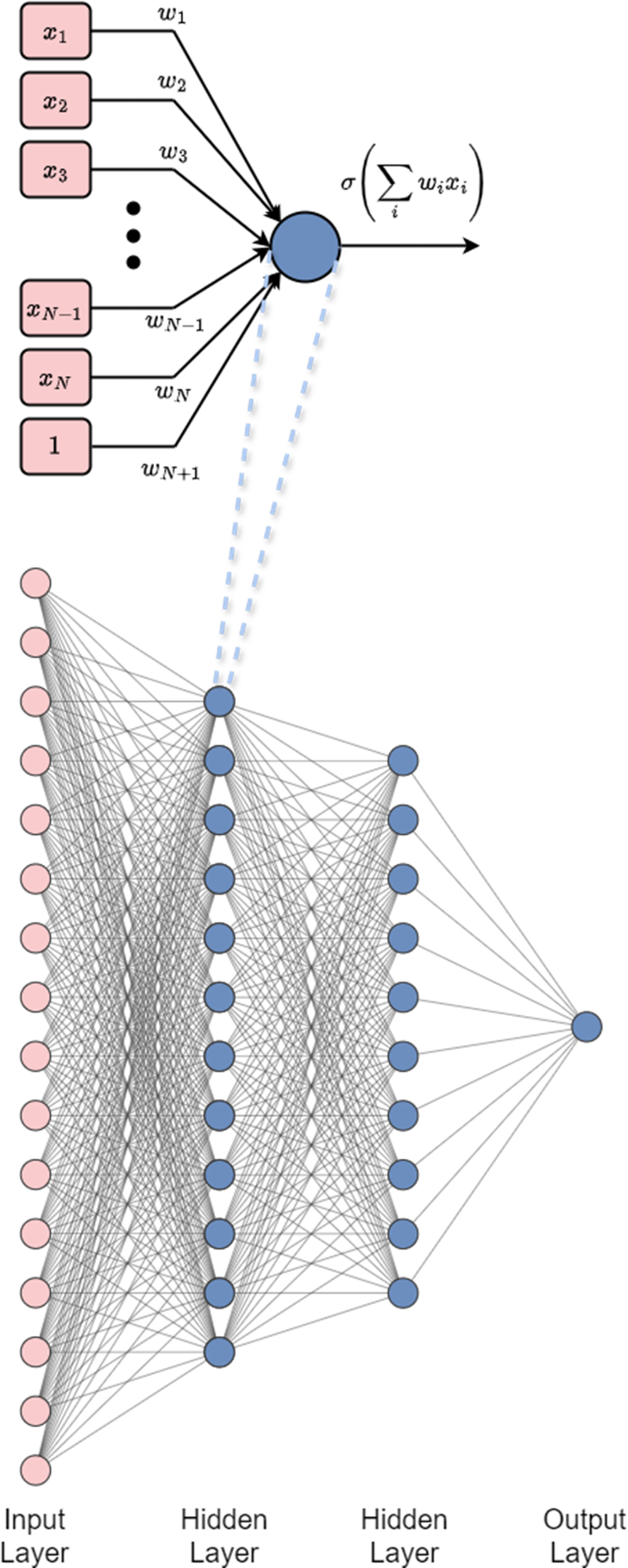
Visualizes how artificial neurons are arranged across hidden layers and chained into a larger network, showing the relationship between depth, width, and computational graphs. section 8.2.1





















