A neural network architecture arranges layers into a forward path that transforms input features into an output. For medical-text risk classification, that path turns padded sequences of token IDs into a probability. section 4.6.6
A text-classification architecture can combine these stages:
- An embedding layer maps each token to a 64-dimensional vector. section 4.6.6
- SpatialDropout1D randomly drops 25% of word vectors during training to reduce reliance on particular words and help prevent overfitting. section 4.6.6
- A GRU processes words in sequence, retaining context from earlier in the text. section 4.6.6
- A dense layer with sigmoid activation returns one probability between 0 and 1. section 4.6.6
Medical risk classification
Descriptions are tokenized using a vocabulary capped at 20,000 words, then padded or truncated to 180 integers. The network processes them through the embedding, dropout, GRU, and sigmoid-output stages to classify risk. section 4.6.6
Figure 4.12 The classification pipeline architecture
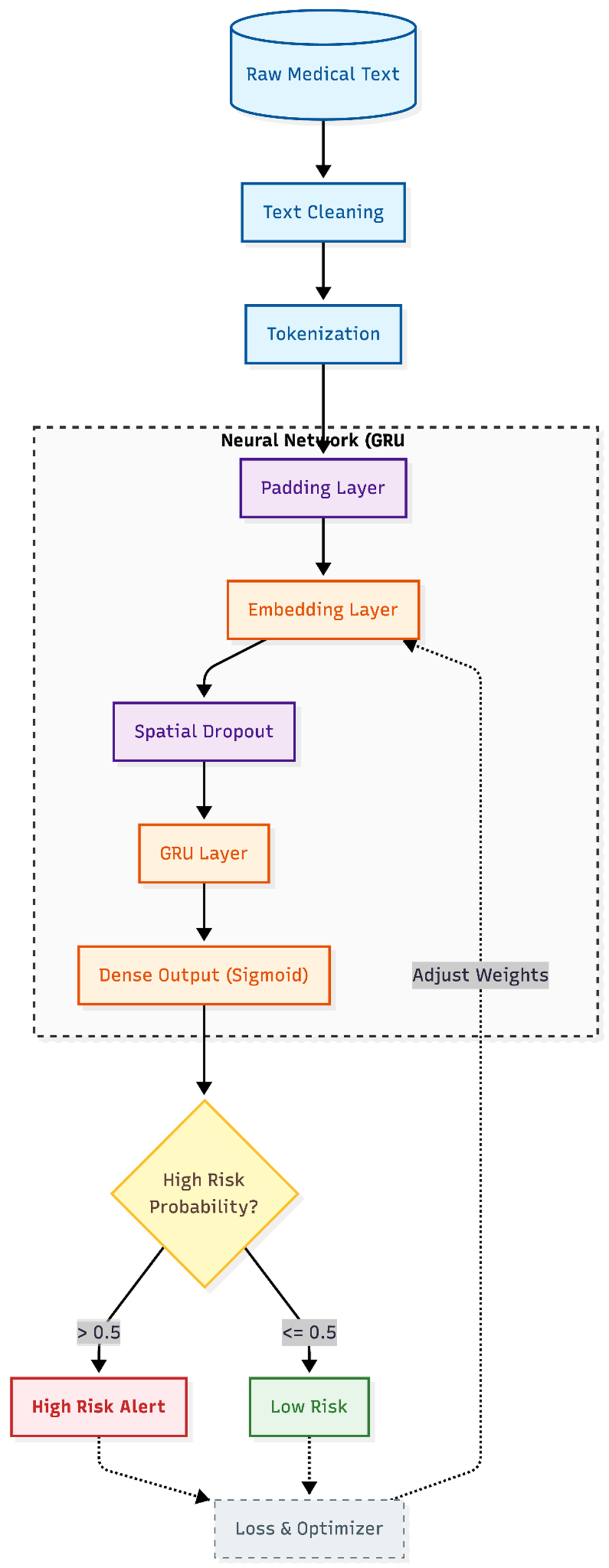
View the classification pipeline as a diagram. section 4.6.6





















