A neural network’s architecture defines how its computational units are arranged and connected. It establishes the route from input values, through hidden layers that transform them, to an output suited to the prediction task. Training adjusts weights and biases along that route; it does not ordinarily choose the number of layers or nodes. section 11.2.1 section 11.3.1 section 11.6.2
Each node combines weighted inputs, adds a bias, and applies an activation function. The weights control the influence of incoming values; the bias shifts the node’s response. Nonlinear activation allows the network to learn relationships that repeated linear combinations could not capture. A layer’s outputs form a representation: a new numerical description of its input. section 11.2.1
Width is the number of nodes in a layer; depth is the number of hidden layers. Wider layers can represent more patterns at the same processing stage. Architecture also determines how signals connect, while learned parameters determine how those signals are transformed. section 11.2.1 section 11.6.1
A pedestrian-detection network
A compact feedforward network sends an input x to two hidden nodes. Their outputs can be written h₁ = φ(w₁x + b₁) and h₂ = φ(w₂x + b₂), where φ is an activation function. The output node combines h₁ and h₂ with separate weights and a bias, then applies a final activation to produce a predicted probability. The nodes are not assigned tasks in advance: training adjusts their weights and biases. A separate threshold of 0.3 converts the probability into a braking decision, reflecting the greater cost of a missed pedestrian than an unnecessary stop. section 11.3.1
Figure 11.2 The compact feedforward neural network used in the pedestrian-detection example. The input 𝑥 is transformed at the hidden nodes using weights 𝑤1 and 𝑤2 and biases 𝑏1 and 𝑏2. After activation, the resulting hidden outputs ℎ1 and ℎ2 are weighted by 𝑣1 and 𝑣2 and combined at the output node. The output node then adds its own bias, not shown, and applies a final activation function to produce the predicted probability.
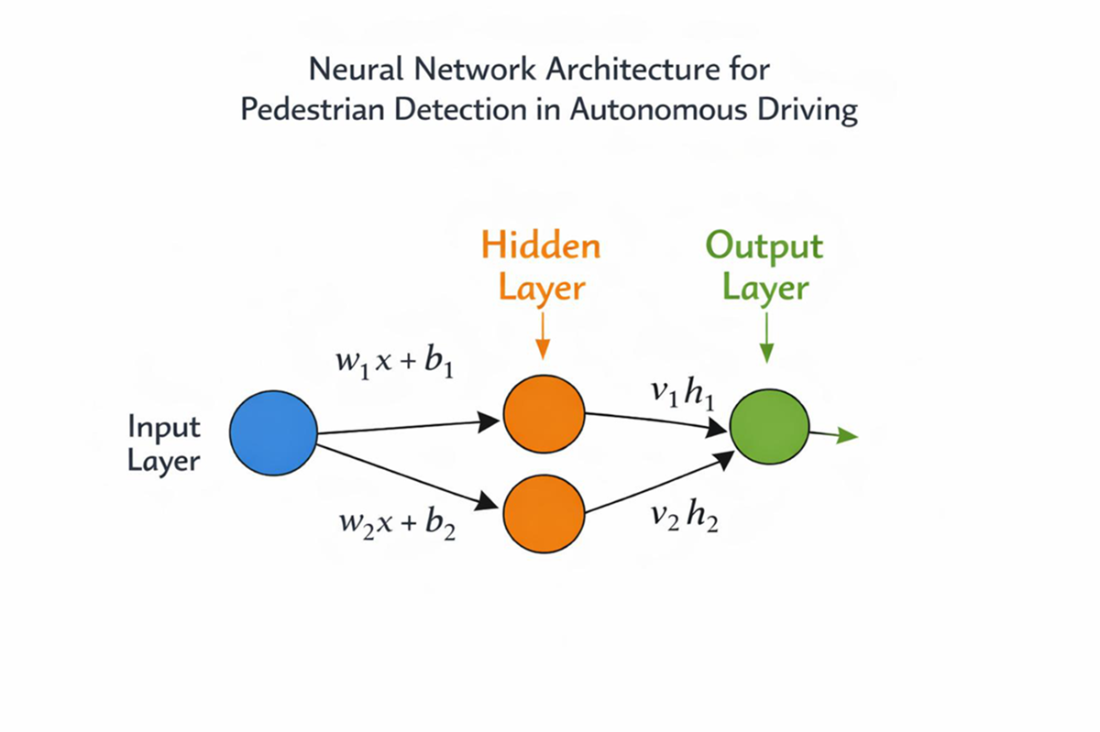
Trace the input through two hidden nodes to the predicted probability. section 11.3.1
Architecture selection balances flexibility and generalization. A network with too little capacity may miss important relationships; unnecessary capacity can increase training cost and susceptibility to training-specific patterns. Train candidate configurations and compare them on validation data, then evaluate the selected configuration on reserved test data. This gives evidence of performance beyond training observations, not proof that the best architecture has been found. section 11.6.1 section 11.6.2





















