Overfitting occurs when a supervised learning model performs well on training data but less accurately on unseen data. It defeats the goal of generalizing to real-world datasets. section 3.2
High dimensionality can increase model complexity, sparsity, processing time, and overfitting risk. The Hughes phenomenon describes performance improving initially as variables increase, then declining after a point. section 3.11 section 3.2
Dimensionality reduction can reduce overfitting by:
- Removing insignificant or correlated variables that add little predictive value. section 3.11 section 3.7
- Using PCA or SVD to transform many variables into fewer components. section 3.11 section 3.7
- Reducing dataset complexity, which can improve model accuracy and shorten training time. section 3.7
Insurance customer data
An insurance dataset may combine useful variables—age, profession, policy amount, income, and defaults—with irrelevant details such as shoe color or shampoo brand. Including every variable increases complexity and can contribute to overfitting; reducing dimensions helps simplify the modeling problem. section 3.2
Figure 3.2 The Hughes phenomenon shows that the performance of a machine learning model will improve initially with an increase in the number of dimensions. But a further increase leads to a decrease in the model’s performance.
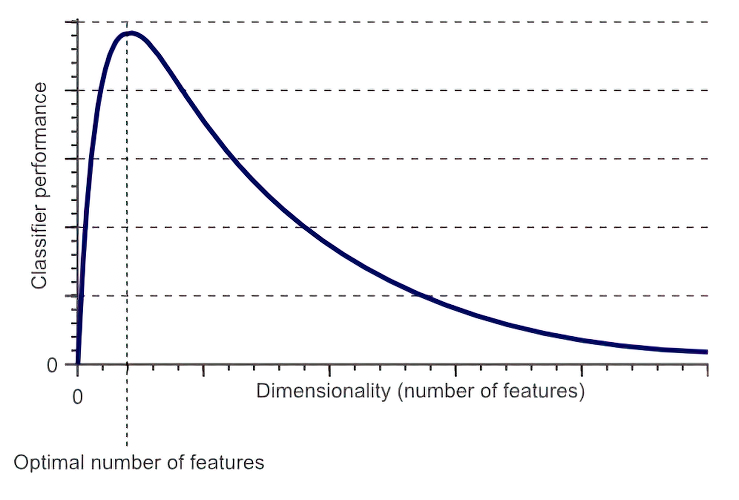
The Hughes phenomenon illustrates why adding variables can eventually reduce model performance, making dimensionality a practical overfitting concern. section 3.2























