Overfitting occurs when a model performs well on training data but poorly on unseen data. It has become too specialized, capturing insignificant details rather than patterns that generalize. section 9.1.1
The problem reflects a bias–variance tradeoff. Increasing model capacity can capture more useful signals and reduce bias, but also increases sensitivity to training-set fluctuations and the risk of overfitting. section 9.1.1
Check these signals and contributors:
- Compare training and validation behavior rather than relying on training performance alone. section 9.1
- Treat decreasing training loss alongside increasing validation loss as a classic high-variance pattern. section 9.1.3
- Investigate excessive model complexity, data leakage, and noisy or highly granular features that encourage irrelevant patterns. section 9.1.1
- Reduce model capacity or increase regularization when the diagnostic pattern confirms overfitting. section 9.1.3
A diverging loss curve
A model’s training loss continues to decrease while its validation loss increases. The model is fitting the training examples more closely without improving on unseen data, indicating potential overfit. section 9.1.3
Figure 9.6 Loss is decreasing for training but not validation, reflecting potential overfit.
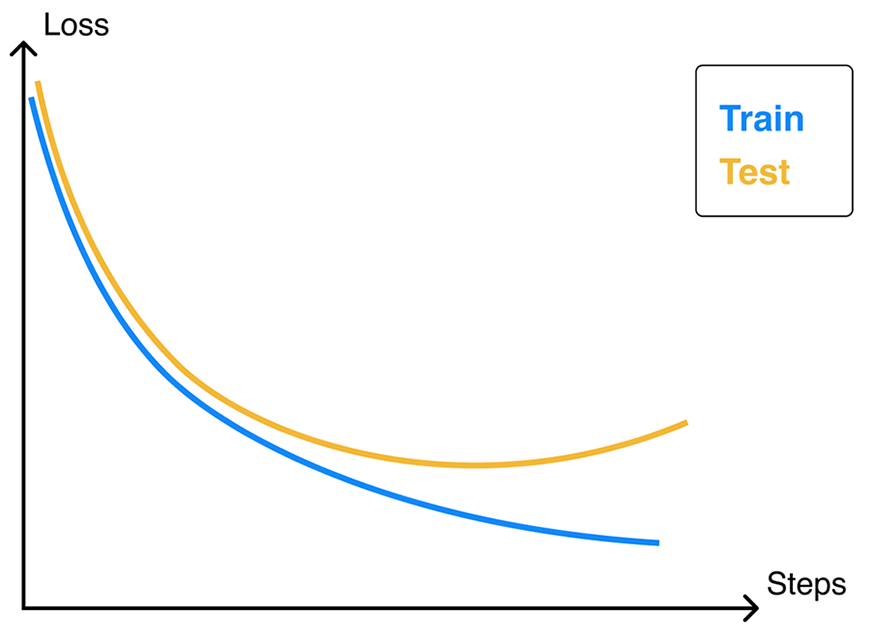
Use the loss-curve figure to recognize the visual pattern in which training loss decreases while validation loss does not. section 9.1.3























