A data frame is a two-dimensional labeled structure organized into rows and columns. In fraud analysis, each row represents a webpage or transaction, while columns hold features, identifiers, and labels. section 2.1 section 3.3.1
Use a data frame to inspect and validate tabular fraud data:
- Load a CSV with pandas, such as assigning pd.read_csv(...) to df. section 2.1 section 3.3.1
- Inspect records with df.head(), dimensions with df.shape, summary statistics with df.describe(include="all"), and column types with df.dtypes. section 2.1 section 3.3.1
- Check data quality through type consistency, missing-value checks, duplicate detection, and identification of object columns. section 3.3.1
Phishing dataset
A phishing data frame contains 10,000 webpage rows and 50 columns: 48 calculated features, an id column, and CLASS_LABEL, where 0 marks genuine pages and 1 marks fraudulent pages. section 2.1
Online transaction dataset
A transaction data frame contains roughly 6.36 million rows and 11 columns, including transaction type, amount, balances, sender and recipient identifiers, isFraud, and isFlaggedFraud. section 3.3.1
Figure 3.5 Steps in loading and cleaning the online transaction fraud dataset.
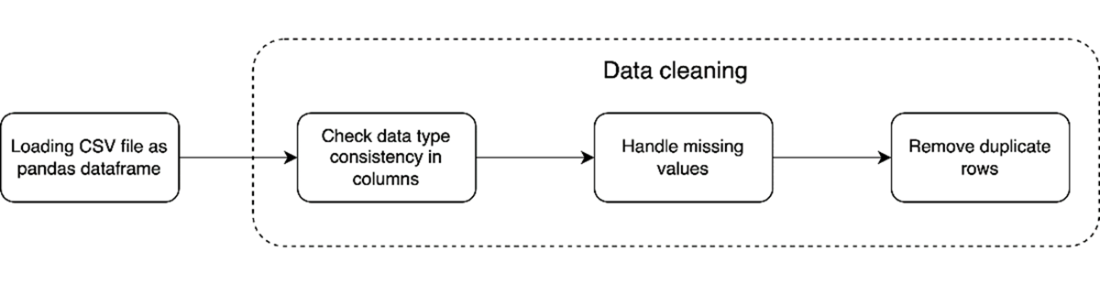
Follow the loading-and-cleaning workflow from CSV import through structural and data-quality checks. section 3.3.1