An objective function expresses what a decision or learning procedure seeks to optimize. A retailer, for example, might minimize the combined cost of ordering, holding, and running out of inventory. The function gives the model a measurable goal; constraints specify the limits within which decisions must be made. section 1.3 section 1.4
In a business model, decision variables represent choices such as order quantities or prices. External factors, such as demand forecasts, supply inputs to the model. Objectives can be minimized or maximized, and a problem may have more than one objective, such as reducing cost while balancing workload. section 1.3 section 1.4
A bakery’s production objective
A bakery earns $5 per chocolate cake and $4 per vanilla cake. If x₁ and x₂ are the respective quantities, its objective is to maximize 5x₁ + 4x₂. Production is limited by 100 labor hours and 150 kg of flour: chocolate cakes require 2 hours and 3 kg each, while vanilla cakes require 1 hour and 2 kg each. The objective measures profit; the resource limits constrain the choices. section 1.6.1
Figure 1.6 Linear programming formulation of bakery shop problem.
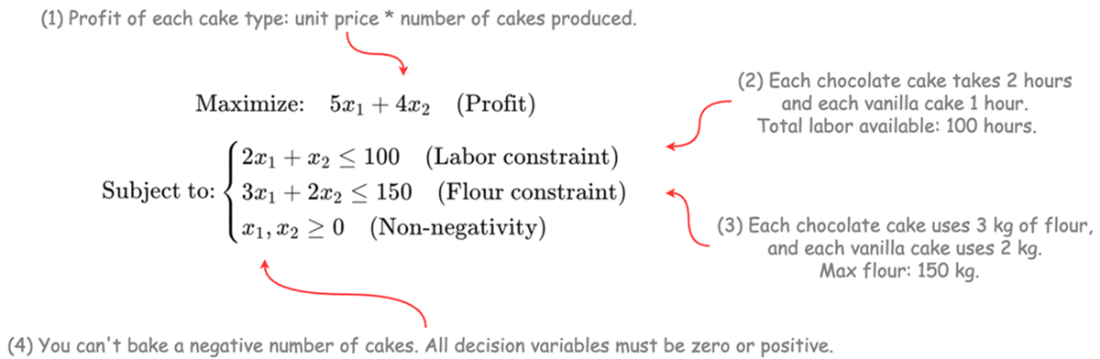
See how the bakery’s objective and resource constraints fit together in a linear programming formulation. section 1.6.1
In policy-gradient reinforcement learning, the objective J(θ) is the expected discounted cumulative reward from following a policy with parameters θ. It averages returns over possible trajectories: sequences of states, actions, and rewards. Gradient ascent adjusts θ in the direction that increases this expected return; the learning rate controls the step size. section 9.2
Different learning algorithms turn their targets into objectives differently. DQN minimizes a regression loss between a prediction and its target. Policy-gradient methods instead use an objective based on the log-probability of actions, weighted by their advantage; PPO and GRPO use a clipped surrogate to limit updates. section 12.1