A latent space, or embedding space, is a continuous mathematical space where data becomes vectors. Distances and relationships between vectors represent properties of the underlying data, making similarity search possible. section 5.4.1
A practical embedding workflow uses:
- A user query converted into a query vector. section 5.4.1
- Known items represented as precomputed vectors in the same space. section 5.4.1
- Similarity search that compares distances and ranks the closest items. section 5.4.1
- Attributes such as “pasta” or “creamy” acting as dimensions that influence each vector’s position. section 5.4.1
Figure 5.8 The concept of embeddings using a restaurant menu analogy. The “embedding space” represents a multidimensional space where both customer orders (queries) and menu items are mapped as vectors. Each menu item (e.g., spaghetti carbonara) is a precomputed vector, while the customer order is converted to a query vector. Similarity between items is determined by their proximity in this space. Attributes like “pasta” or “creamy” represent dimensions of the embedding space. A similarity search finds the closest match and items similar to the query, mirroring how embedding-based systems in machine learning find relevant results for given inputs.
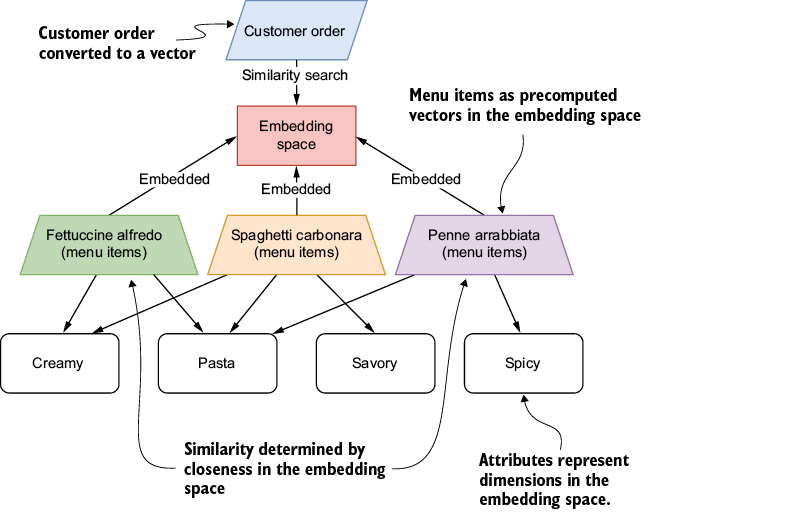
Use the restaurant-menu diagram to trace how a query and menu items become vectors, then how proximity produces similar results. section 5.4.1

















