A latent representation is a learned internal encoding z of input data x. It is not directly observed; it emerges when an encoder transforms x into a compact space that preserves information useful for later machine-learning tasks. section 7.1
In an autoencoder, the encoder computes fin(x) = z and the decoder reconstructs fout(z) = x. Reconstruction alone permits the identity shortcut, so bottlenecks or denoising constraints force z to capture structure rather than merely copy the input. section 7.1
Use the representation with care:
- A two-dimensional z supports scatterplots and visual inspection, but an overly narrow bottleneck can discard important variation and produce incorrect reconstructions. section 7.2.2
- A larger bottleneck can preserve fine details, although better reconstruction does not automatically prove that z is useful for the intended downstream task. section 7.3
- Useful representations can support clustering, search, classification, reconstruction, or controlled manipulation of generated images. section 7.1 section 9.6
Handwritten digits
An autoencoder may map varied handwritten 5s toward a common prototype while preserving distinctive curves and styles when given more latent features. With only two dimensions, a difficult 4 can be reconstructed as another digit because the representation lacks enough capacity. section 7.2.2 section 7.3
Figure 7.2 The process of autoencoding. The input goes through an encoder that produces a new representation of the data z. The representation z can be useful for lots of tasks like clustering, search, and even classification. The decoder attempts to reconstruct the original input x from the encoding z.
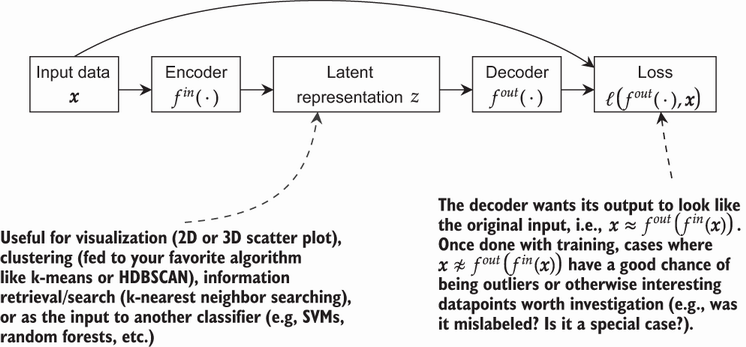
Follow the encoder-decoder flow from input x to latent vector z and back to a reconstruction; the diagram also locates downstream uses of z. section 7.1

















