A latent space is a lower-dimensional continuous space whose vectors compress information while preserving useful structure. For graphs, an encoder maps nodes into vectors using position, neighborhood structure, features, or a combination of these. section 11.3.1
Graph embeddings organize latent vectors according to graph relationships:
- Place connected or nearby nodes close together, and separate disconnected or distant nodes. section 11.3.1
- Use an encoder alone, or jointly optimize an encoder and decoder to preserve specified graph information. section 11.3.1
- Distinguish transductive methods, which represent only training nodes, from inductive methods, which generalize to unseen nodes or graphs. section 11.3.1
Node embeddings with a graph convolutional network
A practical pipeline loads the Cora dataset with PyTorch Geometric, applies two GCNConv layers with ReLU and dropout, trains with Adam for 200 epochs, and evaluates the model.
Figure 11.4 Graph embedding
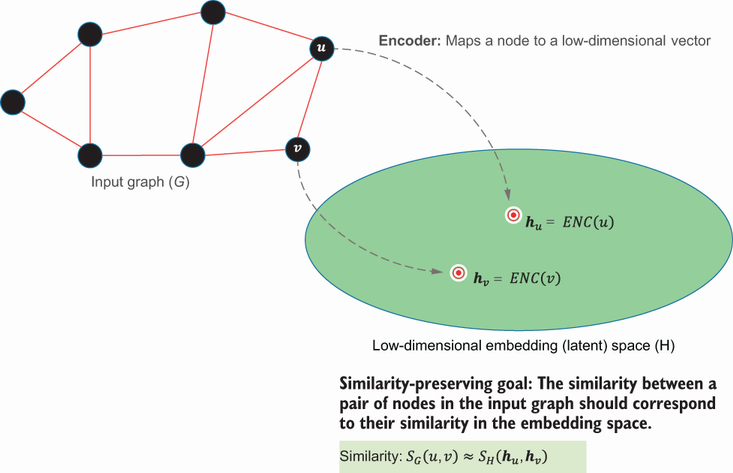
Visualizes the mapping from graph space into a low-dimensional embedding or latent space. section 11.3.1

















