A latent representation is a compressed numerical representation of data. For an image, it captures patterns such as facial expressions, face angles, and skin tones rather than preserving the complete original file. section 4.2
In an autoencoder, an encoder converts an image into latent features, and a decoder reconstructs an image from those features. Using one encoder with separate decoders can transfer characteristics between faces, supporting face-swapping and other deepfake applications. section 4.2
Face-swapping
The same encoder extracts latent features from Face A and Face B. A decoder trained for Face B then reconstructs Face A's features as a realistic blend, mapping characteristics such as eyes, nose, mouth, and lighting. section 4.2
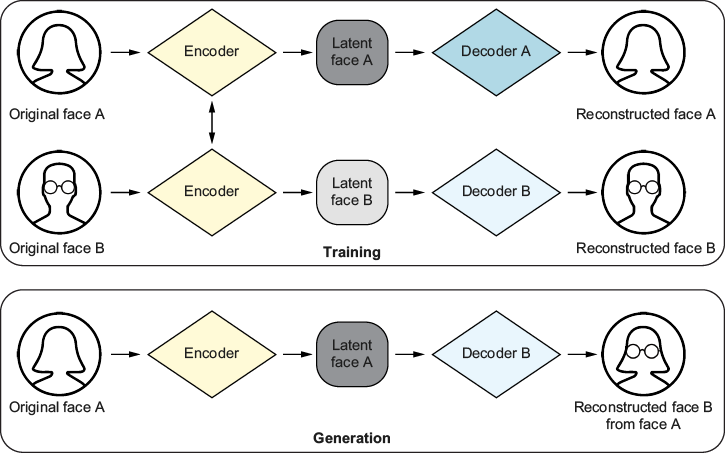
Shows how one encoder and two decoders use latent features to create a deepfake face blend. section 4.2

















