A latent space represents unobserved variables or encoded representations associated with observed data. In an autoencoder, an encoder maps input data through a narrow bottleneck, and a decoder reconstructs the input from that representation. section 11.1
A plain autoencoder can extract features but does not necessarily produce a well-structured latent space. A variational autoencoder instead encodes each input as distribution parameters, samples a latent variable, and trains the space so its points decode to valid outputs. section 11.1
A VAE organizes the space through probabilistic encoding and decoding:
- x denotes the input and z the latent variable. section 11.1
- q(z|x) is the trainable encoder distribution, while p(x|z) is the trainable decoder distribution. section 11.1
- The ELBO objective balances reconstruction quality with a prior-regularized latent representation. section 11.1 section 11.1.1
Joint latent space for time-series anomalies
An LSTM-VAE embeds independent sensor signals into a joint Gaussian latent space approximating standard normal N(0,1). It models normal data without labels; when an anomaly occurs, the input log likelihood drops and can be thresholded as a signal. section 11.1.1
Figure 11.2 Variational autoencoder architecture, showing an encoder, a sampling layer, and a decoder
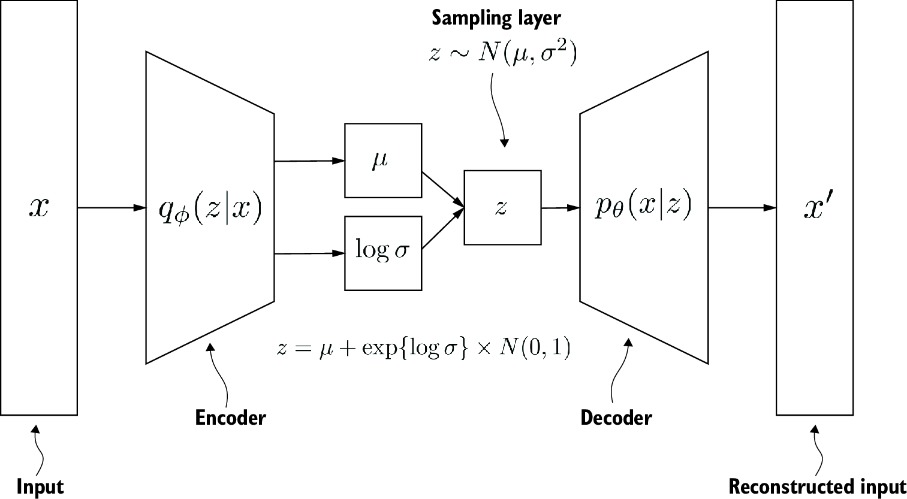
Shows the encoder, sampling layer, and decoder used to form and consume a variational latent representation. section 11.1

















