SQL (Structured Query Language) is conventionally associated with relational database systems. It works with data arranged in tables of rows and columns, where each table represents a record type such as Users, BoardGames, or Comments. section 4.1.1
SQL shapes both the database design and the operations used by the board-game API:
- Models records with fixed-schema tables whose columns remain consistent across records. section 4.1.1
- Represents relationships between records through primary keys and references stored in related tables. section 4.1.1
- Supports the CRUD operations represented by INSERT, SELECT, UPDATE, and DELETE queries. section 5.0
- Fits data that has a known, consistent structure and does not require near-term horizontal scaling. section 4.1.2
Choosing SQL for board-game data
Suppose a CSV file contains board-game IDs, names, publication years, and related fields. Importing it into a relational DBMS provides a structured store for the web API. The API can then use EF Core’s ApplicationDbContext and LINQ operations to perform reads and writes, while EF Core handles the database interaction without requiring application code to write SQL directly. section 4.1.2 section 5.0
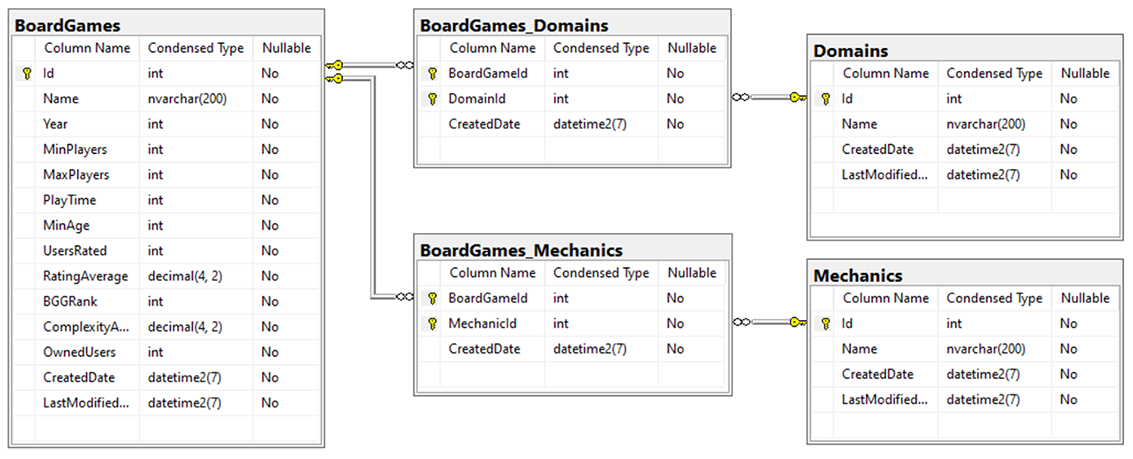
Use the relational schema diagram to inspect how board-game entities are organized as tables and connected through relationships. section 4.1.1
























