Training improves a pretrained language model by updating its weights through additional training, turning a conventional base model into a dedicated reasoning model. It follows evaluation in the build workflow: measure the baseline, train, then evaluate again to determine whether reasoning behavior improved. section 1.7
The workflow positions training after the baseline model and evaluation tools:
- Load an existing pretrained base LLM rather than training a model from scratch. section 1.7
- Evaluate reasoning behavior before and after training so the change can be measured. section 1.7
- Use training-time methods based on reinforcement learning and distillation. section 1.7
Figure 1.9 A high-level road map of what we’ll build in this book. We’ll start with a conventional LLM, add evaluation methods so we can measure its progress, and then explore two broad families of reasoning improvements: inference techniques and training techniques.
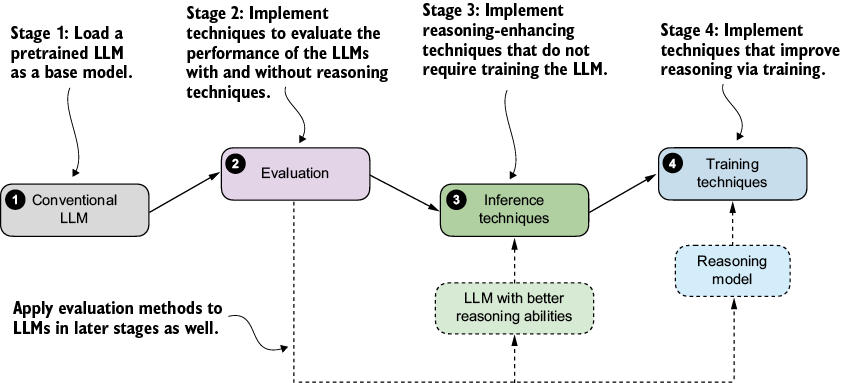
The roadmap shows training as one of two improvement families, alongside inference techniques, within a measure-and-improve loop. section 1.7























