Model training is an iterative optimization process that learns parameter values from examples so predictions improve. Neural networks adjust interconnected components across many layers to learn increasingly complex patterns. section 1.6
A useful mental model separates two stages:
- Training learns the model’s parameter values from examples. section 1.6
- Inference uses the trained model to complete or predict text. section 1.6
- Fine-tuning enhances a pretrained model for a more specific purpose. section 1.6
From patterns to prediction
A trained language model can use learned relationships in a question such as “What is the capital of Italy?” to predict “Rome.” Attention helps it focus on relevant input words, such as “Italy.” section 1.6
Figure 1.12 The two stages of GPT-3. First, it gets trained, and then the sentence completion is inferred.
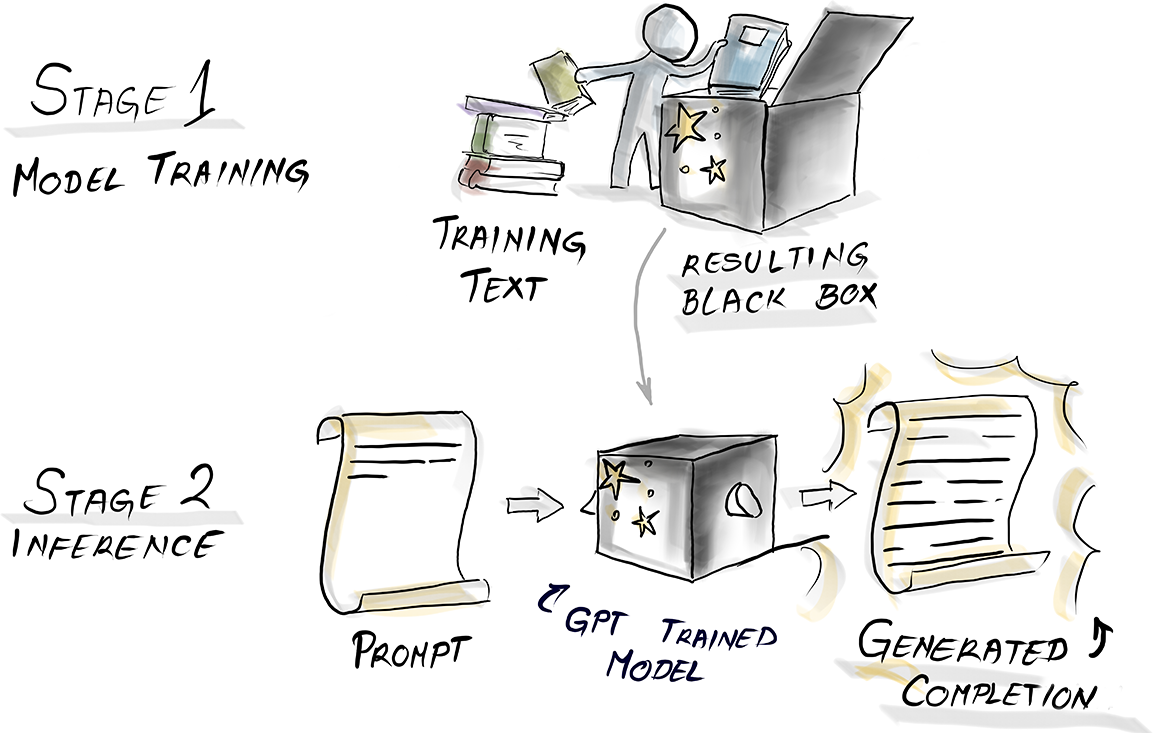
Trace the distinction between GPT-3 training and sentence-completion inference. section 1.6























