liveBook · Manning

Training

As explained in Machine Learning System Design

Model training is the process of fitting a machine learning model to data by adjusting its learned parameters.

Model training adjusts learned parameters using preprocessed data to produce a trained model. It is the core, usually longest and most complex step in a training pipeline. section 10.1.1

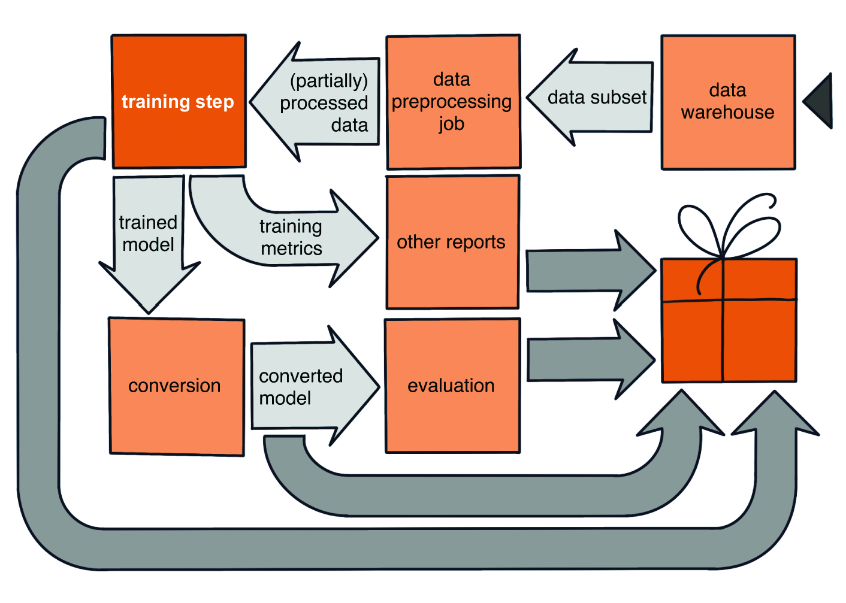
A typical training pipeline moves through these stages:

  • Fetch data, preprocess it, and train the model. section 10.1.1
  • Evaluate and test the trained model, then postprocess, generate a report, and package artifacts. section 10.1.1
Figure 10.1 A DAG scheme representing a training pipeline
figure

A DAG diagram shows the training pipeline as a sequence of connected steps. section 10.1.1

How Machine Learning System Design covers it

How deep it goes
Outlines pipeline stages and identifies training as complex, while leaving data fetching details and inference pipelines aside.
Examples
Uses feature selection as training-specific preprocessing and neural-network gradient descent to illustrate repeated inference steps.
What it assumes
Assumes data is available for preparation and defines preprocessing as actions that ready data for training.
What you can do after
Build a trained model from preprocessed data as one step in a larger pipeline.
How it connects
Connects model training with preprocessing, feature selection, model evaluation, and inference pipelines.

Also explained in

Compare how 24 books explain training →

Related concepts

This explainer was generated by Manning's knowledge graph from the text of Machine Learning System Design. The section links point to the parts of the book it draws on.





















