Uncertainty arises when available information does not determine one interpretation or outcome. In artificial intelligence, ambiguity, contradiction, and incomplete information exposed limits of rule-based systems. Probabilistic models and learning algorithms shifted the emphasis toward inference under uncertainty. section 1.7
In language generation, uncertainty can appear when several possible next tokens have similar probabilities. A model still selects a continuation, even when no option is strongly supported. Its training favors plausible sequences rather than requiring factual verification or an explicit representation of uncertainty. section 6.1.2 section 6.2.2
Figure 6.1 Models learn patterns from training data and extend them to new cases. In this example, animals associated with water are often labeled as fish. When no clear example is available, as with the dolphin, the model does not stop or admit uncertainty. It continues by extending the strongest available pattern, incorrectly classifying the dolphin as a fish rather than a mammal.
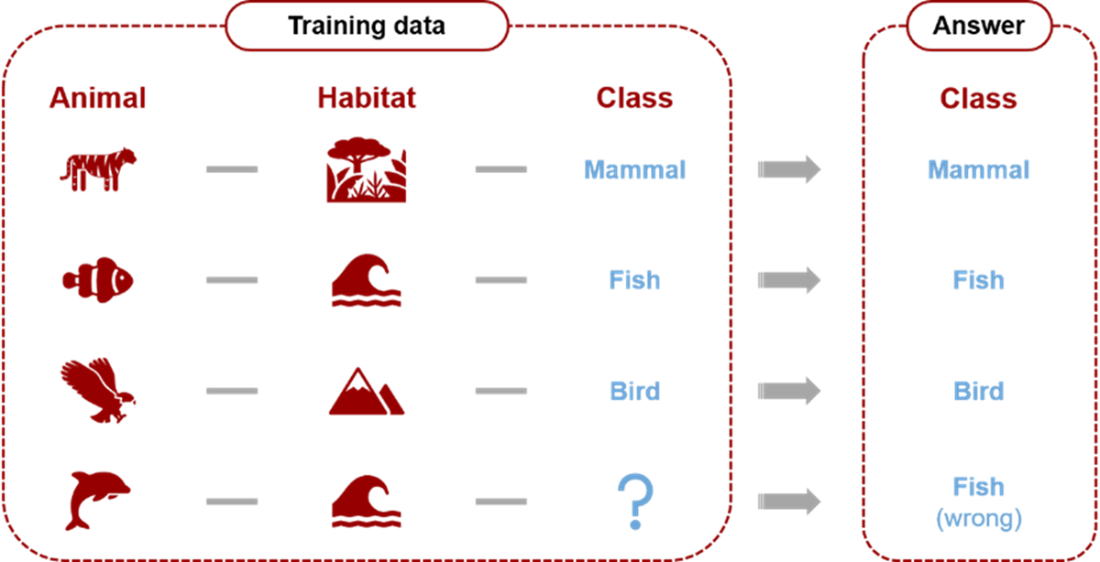
The dolphin example illustrates how extending a familiar pattern can produce a confident but incorrect classification when a clear example is unavailable. section 6.1.2
Evaluation and fine-tuning can also favor attempting an answer over declining, even when support is weak. A fluent or decisive response is therefore not, by itself, evidence that the model has verified its claim. section 6.1.2 section 1.7
One monitoring approach tracks how uncertainty changes during generation by examining the distribution of probabilities across likely next tokens. Uncertainty that accumulates across competing alternatives can signal a higher risk of hallucination. This identifies portions that may need verification; it does not establish whether a statement is true or eliminate errors. section 6.2.2
Figure 6.5 Uncertainty in token prediction. When a model assigns high probability to a single continuation, generation is stable and strongly constrained. When multiple alternatives have similar probabilities, the model operates under higher uncertainty, increasing the likelihood of unsupported or fabricated outputs.
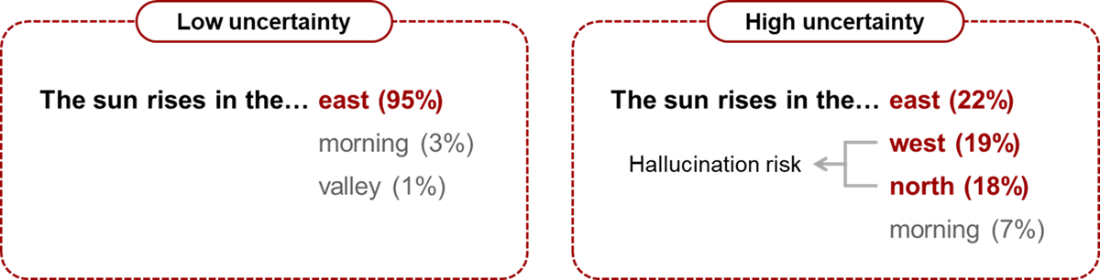
The figure contrasts a dominant next-token choice with several similarly likely alternatives, making the uncertainty signal visible. section 6.2.2