Architecture meets uncertainty when requirements, constraints, ownership, priorities, and future conditions are incomplete or shifting. A diagram can look coherent before delivery begins, yet a smaller team, security review, missing legacy documentation, tighter budget, or unclear stakeholder need can make its assumptions untenable. The architectural task is not to defend the original design approval; it is to turn ambiguity into technical direction while keeping consequences visible. section 1.0
There is no perfect solution independent of context. A decision is good enough only for a particular situation and moment, and may become a limitation or technical debt as people, requirements, business priorities, and constraints change. Uncertainty therefore makes architecture a continuing loop of intent, forces, decisions, consequences, feedback, and adaptation rather than a static design artifact. section 1.0 section 1.3
Under uncertainty, make the trade-off explicit:
- Avoid committing to an imagined end-state design before evidence justifies it; doing so extends design time, delays delivery, and turns assumptions into hard-to-reverse anchors. section 3.3
- Deliver an early slice of value, observe how the system behaves, and strengthen the design as evidence improves. section 3.3
- Commit early where reversal is expensive, including data ownership, security boundaries, integration contracts, deployment model, and operational responsibilities. section 3.3
- Defer choices that can safely wait, while retaining a view of likely future needs rather than designing only for the next ticket. section 3.3
An uncertain greenfield system
Loose requirements, an immature domain understanding, unknown throughput and user numbers, and partly visible integrations make an end-state architecture speculative. A good-enough approach starts with a valuable slice and preserves room to evolve. Its discipline is selective: establish foundations whose later change would spread across pipelines, infrastructure, access control, support procedures, persistence, and integration, but keep uncertain boundaries coarse until the system provides stronger evidence. section 3.3
Figure 3.3 Designing for the ideal end state often delays first value and pushes feedback later, when reversal is more expensive. A good-enough and evolvable approach delivers an early slice, uses feedback sooner, and strengthens the architecture as evidence improves.
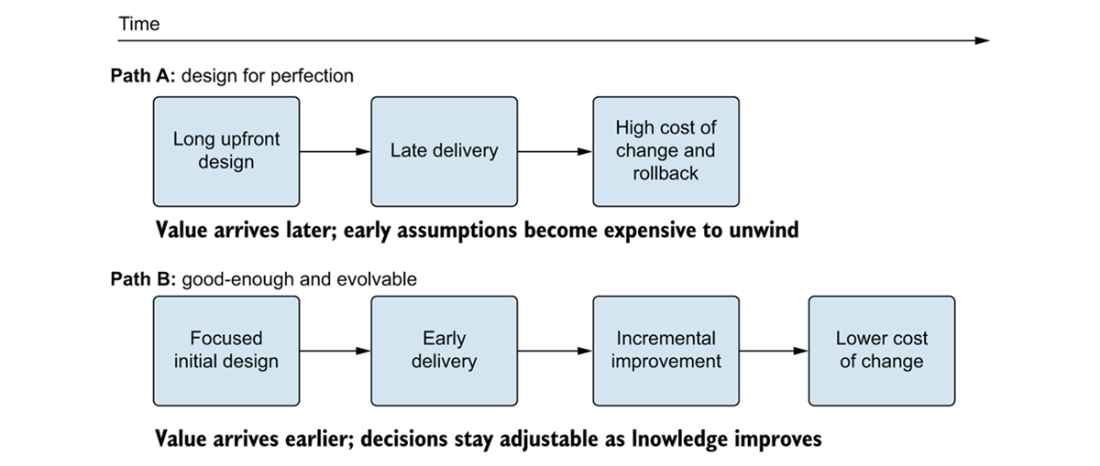
Compare the delayed-feedback cost of designing for an ideal end state with an early-slice path that learns sooner and makes reversal cheaper. section 3.3
Uncertainty is also operational and organizational. A technically flexible design can be the wrong choice when it assumes deployment patterns, distributed monitoring, failure analysis, or operational discipline the organization cannot yet sustain. A conservative design with fewer deployable parts, familiar technologies, explicit integrations, and established operating practices may better fit low risk tolerance, compliance pressure, unclear ownership, and limited incident-response capacity. section 2.4
Use uncertainty as a reason to expose assumptions and revisit triggers, not as a reason to postpone all architecture. Favor decisions that match current evidence, distinguish costly commitments from deferrable choices, and change direction when production behavior, organizational capability, or business conditions invalidate the earlier trade-off. section 1.0 section 3.3