Variance measures spread by describing the expected squared deviation of a random variable from its mean. In a multivariate Gaussian, each variable’s variance appears on the covariance matrix’s diagonal. section 2.2.1
Read variance in a multivariate Gaussian as follows:
- The mean vector records the expected value of each variable. section 2.2.1
- The i-th diagonal entry of the covariance matrix gives the variance of variable Xi. section 2.2.1
- Larger variance corresponds to a wider marginal normal distribution and greater uncertainty around its mean. section 2.2.1 section 2.2.2
Updating uncertainty after an observation
Suppose A, B, and C represent jointly modeled house prices. Conditioning the Gaussian on an observed value such as B = 4 changes A’s posterior mean and reduces its error-bar range when A and B are positively correlated. At the observed variable, uncertainty becomes zero; variables with no relevant correlation may retain their marginal distributions. section 2.2.2
Figure 2.4 An MVN distribution groups multiple normally distributed random variables together. While the mean vector of the MVN concatenates the mean values, the covariance matrix models the correlations between the individual variables.
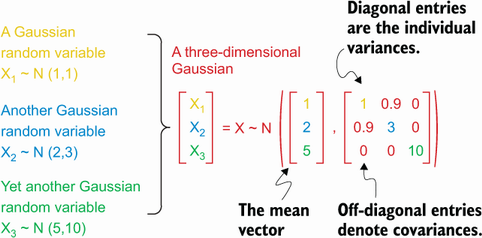
Shows how a multivariate Gaussian groups individual normal variables while its covariance matrix represents their variances and correlations. section 2.2.1
Figure 2.5 Parallel coordinates plot visualizing a mean-normalized MVN from the housing price example. The error bars indicate 95% CIs of corresponding normal distributions, while the faded lines show samples drawn from the multivariate Gaussian.
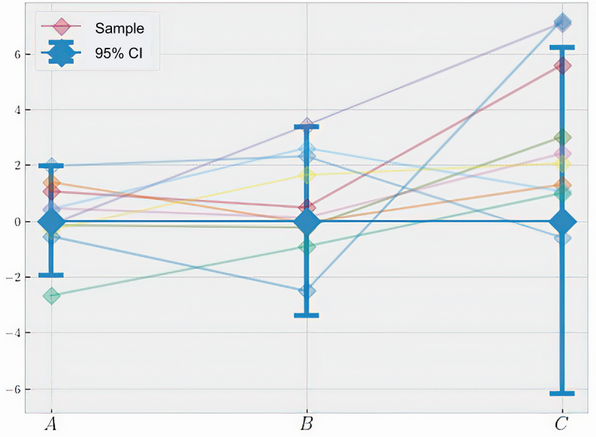
Visualizes marginal uncertainty with 95% confidence intervals and samples from a multivariate Gaussian. section 2.2.1
Figure 2.8 Conditioning a Gaussian on an observation is similar to tying a knot around that observation. All samples from the posterior distribution need to pass through the knot, and there’s no uncertainty at the observed point.
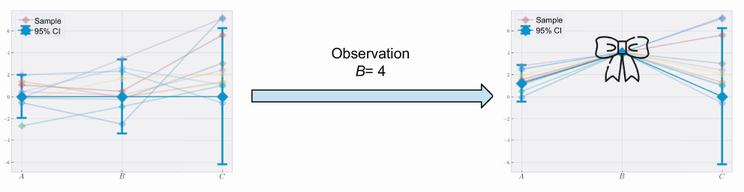
Illustrates conditioning as forcing posterior samples through an observed value, leaving no uncertainty at that point. section 2.2.2


















