A parameter is a numerical value used by a model and typically learned or adjusted during training. Model parameters, also called model weights, determine how the model transforms inputs into predictions. section 5.3.1 section 6.3.3
Training changes parameters to reduce a loss. A denoising diffusion model adds noise to clean images, gives the noisy images and time steps to a U-Net, compares predicted noise with actual noise, and adjusts the parameters to minimize the error. section 5.3.1 section 6.3.3
Parameters appear in several practical roles:
- Count them to estimate model scale: one U-Net configuration contains more than 133 million parameters. section 7.3.1
- Save them after training as a model state dictionary so the trained model can be reused. section 6.3.3
- Learn them for different objectives: diffusion models minimize noise-prediction error, while VAEs balance reconstruction loss with latent-distribution alignment. section 6.3.3 section 9.1.1
A parameter update in a denoising model
For each batch, the DDPM supplies noisy clothing-item images and labels to a denoising U-Net. The loss measures the difference between actual and predicted noise; backpropagation and the optimizer then update the U-Net's parameters. section 5.3.1
Figure 5.8 Steps to train a denoising U-Net model to remove noise from images
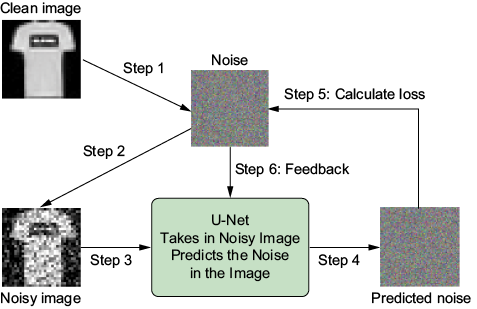
Follow the training pipeline from clean images and sampled time steps through noise prediction, loss calculation, and parameter adjustment. section 5.3.1






























