A parameter is a tunable value inside a model function. The model’s architecture specifies which parameters exist; training estimates their values from data. Once estimated, they fix how the model maps an input to an output, allowing inference on new inputs. section 1.1 section 1.3.6
In a weighted-sum model, y = w0 × hardness + w1 × sharpness + b, w0 and w1 are weights and b is a bias. Weights scale input features, whereas the bias is a constant not multiplied by an input. Together, these three values determine the threat score. section 1.1 section 1.3.4
Figure 1.1 Examples of decision making and quantitative estimations in life
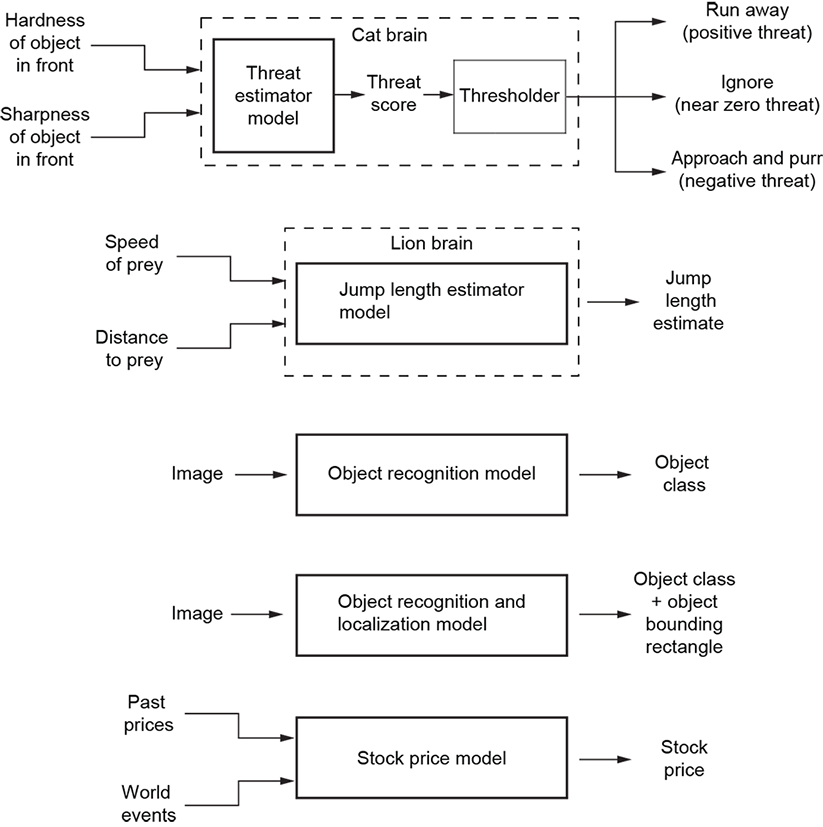
Quantitative features can enter a parameterized decision function whose learned weights and bias turn them into a threat score. section 1.1
Parameters take different forms as the model family changes:
- A neural-network linear layer uses a weight matrix W for all connections between two layers, together with biases; matrix notation handles all neurons at once. section 8.3.1
- A convolution uses kernel weights repeatedly across neighboring input positions; its equivalent matrix is sparse and block-diagonal. section 10.1.3
- A Gaussian distribution uses parameters such as mean and variance, while a Gaussian mixture model uses component weights, means, and covariance matrices. section 5.7 section 6.9.4
- Bayesian estimation treats parameters θ as uncertain: a prior belief and the data likelihood combine into a posterior distribution over their values. section 13.11
Training is function fitting. Given inputs with known outputs, supervised training adjusts parameters to reduce the discrepancy between predictions and ground truth. Large-scale learning commonly proceeds iteratively on small portions of data, starting from random parameter values and making small improvements. Training may reach a local minimum rather than the best possible values, so held-out test data helps judge whether to stop or revise the data, loss function, or architecture. section 1.3.5 section 8.4
Fitting a mixture model
For unlabeled height-and-weight points, a GMM fixes the number of components K and estimates each component’s mixing weight πk, mean μk, and covariance Σk. The fitted mixture should produce a point cloud that overlaps the observed clusters. Because the likelihood equation has no closed-form solution for these values, fitting uses an iterative approximation with E- and M-steps until likelihood stops increasing. section 6.9.4
Parameter values are not merely storage for numbers: they express the particular model selected by data. A Gaussian family cannot be used until its mean and covariance are known; similarly, a neural architecture becomes a usable predictor only after its weights and biases have been estimated. With little data, Bayesian priors can materially influence the estimated values; with abundant data, likelihood dominates. section 6.6 section 13.11






























