liveBook · Manning

Parameter

As explained in Designing Deep Learning Systems: A guide for software engineers

A numerical value in a model that is adjusted during training to determine its behavior.

A parameter is a trainable numerical value in a neural network. Training adjusts parameters to reduce prediction error and improve future accuracy; weights and biases are common examples. section 3.2.1 section 5.1.1

A training workflow changes parameters through a repeatable update loop:

  • Feed a mini-batch through the network to produce predictions. section 3.2.1
  • Compare predictions with labels through a loss function. section 3.2.1
  • Use backpropagation to calculate gradients for each parameter. section 3.2.1
  • Apply an optimization algorithm, such as stochastic gradient descent, using gradients and a learning rate. section 3.2.1
  • Save the trained network and its parameters when the run or accuracy target is reached. section 3.2.1

Parameters versus hyperparameters

A model learns its parameters during training, while configurations such as 30 epochs, ReLU activation, minibatch size, and learning rate are set beforehand as hyperparameters. section 5.1.1
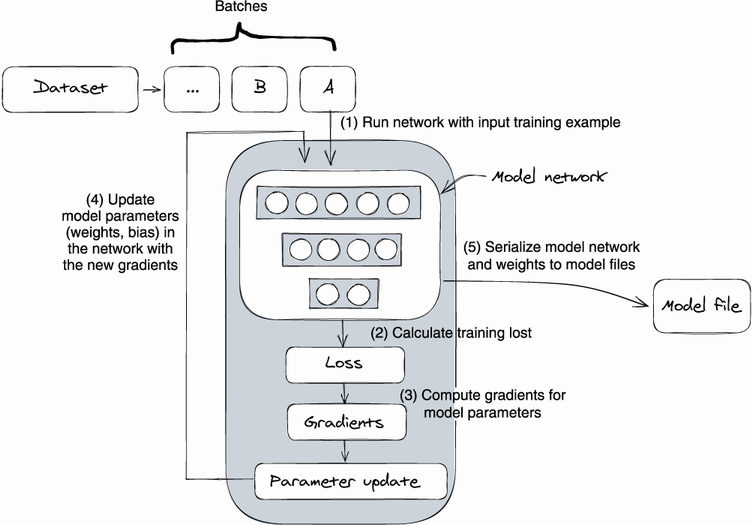
Figure 3.3 General steps of a deep learning model training workflow

Use the workflow diagram to trace how predictions, loss, gradients, optimization, and saved parameters form one training cycle. section 3.2.1


How Designing Deep Learning Systems: A guide for software engineers covers it

How deep it goes
Defines trainability, gradients, weights, biases, and saved state, but stops short of mathematical derivation.
Examples
Uses mini-batches, weights, biases, stochastic gradient descent, large parameter counts, and final model files.
What it assumes
Assumes basic neural-network training concepts while defining the distinction between trainable parameters and static hyperparameters.
What you can do after
Understand how training changes parameters and why parameter scale creates distributed-training requirements.
How it connects
Connects parameters to neural networks, loss functions, backpropagation, optimization algorithms, hyperparameters, and distributed training.

Also explained in

Compare how 31 books explain parameter →

Related concepts

This explainer was generated by Manning's knowledge graph from the text of Designing Deep Learning Systems: A guide for software engineers. The section links point to the parts of the book it draws on.



























