Suppose a causal model says that education affects where someone lives. The graph specifies the relationship; parameters specify the probabilities within it. Changing those values changes the model’s predictions without necessarily changing its structure. section 3.2.3 section 3.2
A parameter is a value that characterizes a probability distribution or another model component. In a regression model or neural network, parameters include weights. In a categorical distribution, they can be outcome probabilities. A distribution class supplies the reusable form; its parameter values specify an instance. section 2.1.6 section 2.1.7 section 2.3.4
Parameterizing a three-outcome distribution
Let ρ₁ and ρ₂ be the probabilities of the first two outcomes. The third is ρ₃ = 1 − ρ₁ − ρ₂ because the probabilities must sum to one. To support a prespecified number Κ of outcomes, use Κ together with ρ₁ through ρΚ₋₁. In pgmpy, distribution values and outcome counts are supplied through arguments such as `values` and `cardinality`. section 2.1.6
Parameter values can be obtained in several ways:
- Fit them from observations, for example by maximizing likelihood or minimizing a loss. L2 regularization discourages exceedingly large estimates. section 2.3.4
- Treat them as random variables in Bayesian estimation, using priors and data to obtain a posterior. section 11.6.3
- Reason about a causal mechanism when learning data is unavailable. For residence conditional on education, population and degree-holder percentages can yield estimated probabilities. section 3.2.3
For causal inference, fitting the observed joint distribution is not the whole objective: the parameters should represent the proposed data-generating process. Each causal Markov kernel has its own parameters. If one underlying mechanism changes, parameter modularity assumes other kernels’ parameters remain unchanged. An estimation workflow fits the parameters, transforms the model for the causal question, then runs probabilistic inference. section 2.3.4 section 3.2.3 section 11.6.3
Figure 11.15 A plate model of the causal DAG with new nodes representing parameters associated with each causal Markov kernel. There is a single plate with N identical and independent observations in the training data. θ corresponds to parameters, which are outside the plate, because the parameters are the same for each of the N data points.
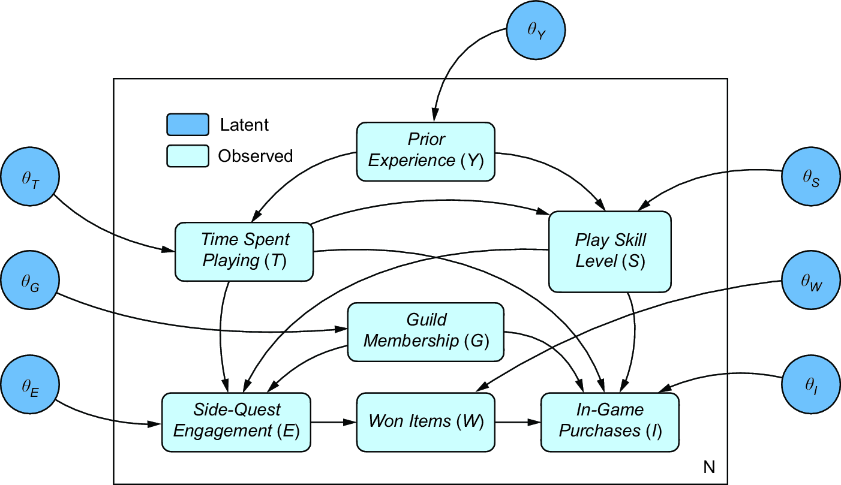
The plate diagram places each kernel’s parameter nodes outside the repeated-observation plate: the same parameters apply across the N data points. section 11.6.3






























