Doubling a thousand numbers one at a time is straightforward, but each element can be doubled without waiting for the others. Parallelism puts multiple processing units to work at the same time on pieces of a problem. The key question is not just how many units are available, but which pieces can run independently. section 1.4 section 1.5
Doubling an array
A scalar loop doubles data[0], then data[1], and continues through data[999]: 1,000 element operations in sequence. A GPU-style approach assigns one thread to each element, so many elements can be processed at once. This is data parallelism: the same operation on different data. The contrast is simplified: CPUs can also process multiple values with SIMD, and a GPU schedules threads in groups rather than running all 1,000 literally at once. section 1.4 section 1.3
Figure 1.2 Parallel processing: every element at once. A GPU assigns one thread per element, doubling all 1,000 values in parallel; the hardware schedules those 1,000 threads onto its many CUDA cores.
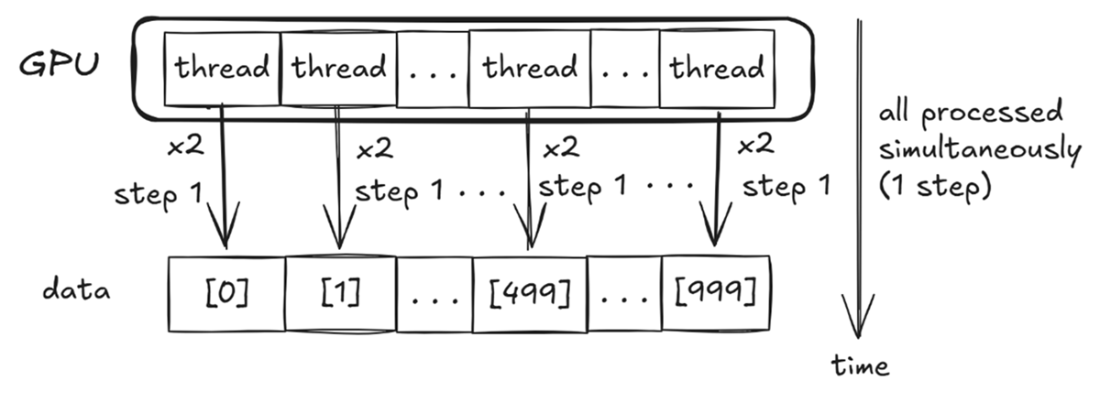
Follow the assignments from GPU threads to array elements to see how the work is divided. section 1.4
A task is a piece of work, such as doubling one element or adding two numbers. If one task needs another’s result, there is a data dependency. That dependency limits what can run at once, but it does not always make the entire problem sequential. In a tournament-style sum, additions within a round can run in parallel, while each round waits for the preceding one. section 1.5
A common mistake is to assume that adding cores guarantees a proportional speedup. Sequential work sets a limit: if 10% of a fixed problem must run sequentially, even infinitely many cores cannot make the whole program more than 10 times faster. This is Amdahl’s Law. Gustafson’s Law considers a different situation, where the problem grows with the number of cores. section 1.5 section 1.10
Parallel work takes several forms:
- Data parallelism applies the same operation to many values, as in array doubling. Task parallelism runs different operations concurrently, such as compressing one file while encrypting another. section 1.3
- MPI coordinates work across machines; OpenMP distributes work across shared-memory CPU cores; SIMD applies one instruction to several values within a core. section 1.3
- CPUs and GPUs can work together: the CPU runs the main program, while the GPU handles large parallel jobs. Independent, regular work suits the GPU; small or dependency-heavy jobs may favor the CPU. section 1.10