Automation executes predefined process steps and decisions in software. People and policies determine the meaningful decisions at design time; rules encode them in workflows, integration logic, or application code. Given the same inputs and system state, deterministic automation produces the same outputs. section 1.2.1
Automating a known process means breaking it into steps, defining rules for each step, and implementing those rules. Unexpected conditions typically cause the system to stop, escalate, or fail according to predefined rules. Automation removes manual work, reduces errors, and scales routine tasks, but does not choose new goals or change its own behavior at runtime. section 1.2.1
Fraud response at 3 a.m.
A compromised-card signal can trigger an automated severity alert, ticket, and page while people verify the data and decide whether to block cards. That review may take hours. An autonomous alternative can assess the threat and freeze accounts within seconds, but may also strand customers and leave accountability unclear. Faster action changes the decision boundary; it does not eliminate the need for governance. section 1.1 section 1.0
Figure 1.1 Deterministic and agentic fraud response flows, showing the shift from human approval to delegated system authority and the move from hours-long governance cycles to autonomous action in seconds.
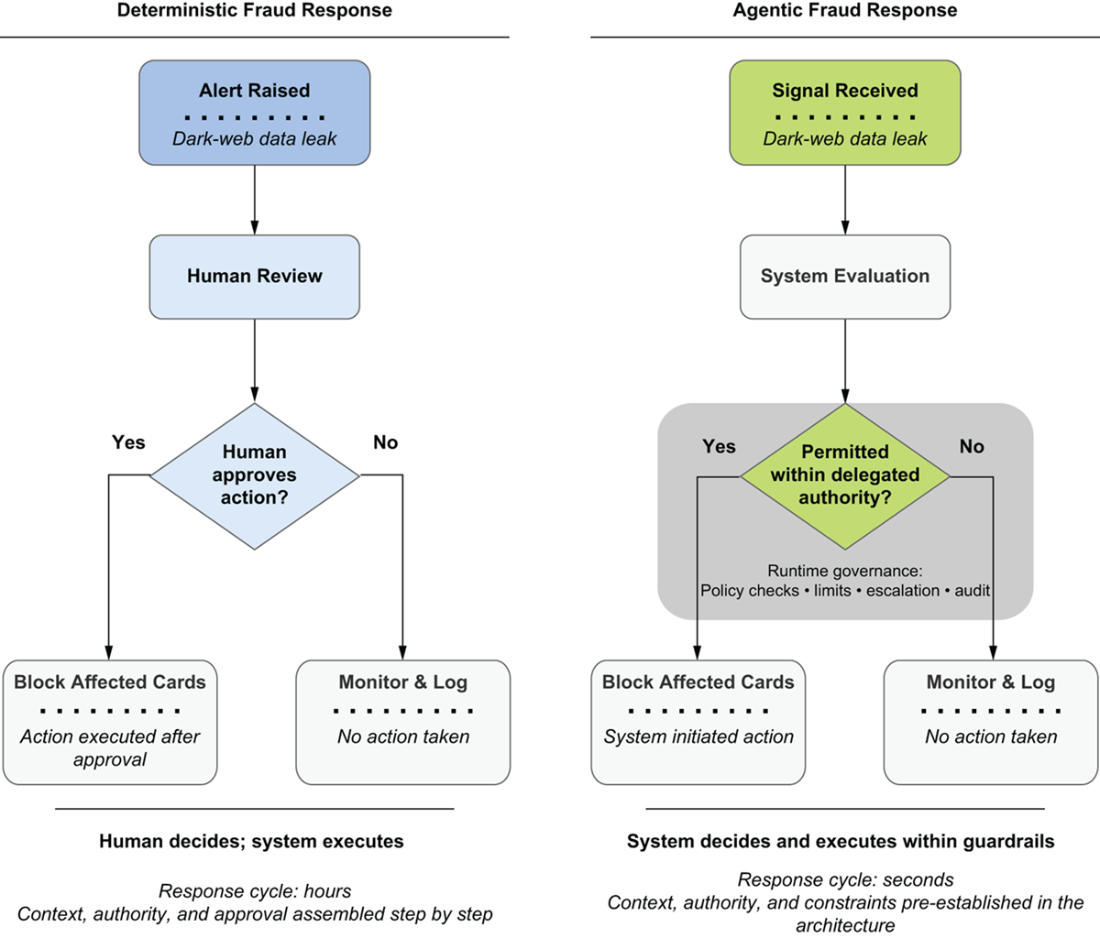
Compare the human approval path with delegated action in the fraud response. section 1.1
Automation executes decisions; autonomy selects actions at runtime within boundaries. The two can coexist in an enterprise workflow. When authority is delegated, runtime guardrails such as policy checks, rate limits, escalation thresholds, and kill switches constrain what the autonomous system can do. section 1.2.1 section 1.2.2
Choose the decision model for the work:
- Favor automation when the process is stable, decision points can be specified in advance, or consistency, traceability, and human review are essential. section 1.2.4
- Consider autonomy when context varies and the next action cannot be predetermined. Weigh adaptability against governance and failure-risk costs. section 1.2.4 section 3.7.1
Economics depend on the planning horizon. In an illustrative comparison, traditional automation has a higher three-year net present value than an agentic system: $680,000 versus $490,000. That advantage assumes a stable environment; changing protocols or rules may require rebuilding the automated solution, while a bounded autonomous system can adapt. section 3.7.1