Automation executes tasks through predefined rules, programs, or training rather than adapting autonomously. It maps specified situations to expected responses and can fail when conditions fall outside what it was designed or trained to handle. section 19.2.2 section 1.10
Automation differs from intelligence in several practical ways:
- Handles narrowly defined requirements or situations represented in its programming or training. section 1.10
- May generalize locally to inputs resembling familiar examples, but does not reliably manage unexpected situations. section 19.2.2
- Requires broad scenario coverage because robust behavior depends on accounting for possible cases in advance. section 1.10
- Contrasts with intelligence, which adapts to novelty, reasons about situations, and learns with little or no new data. section 19.2.2
Rigid rule-based automation
A lookup table, dictionary, or hardcoded if-else question-answering program responds to cases explicitly described in advance. When given an unfamiliar case, it has no adaptive strategy for finding a way forward. section 19.2.2
Figure 19.6 Local generalization vs. extreme generalization
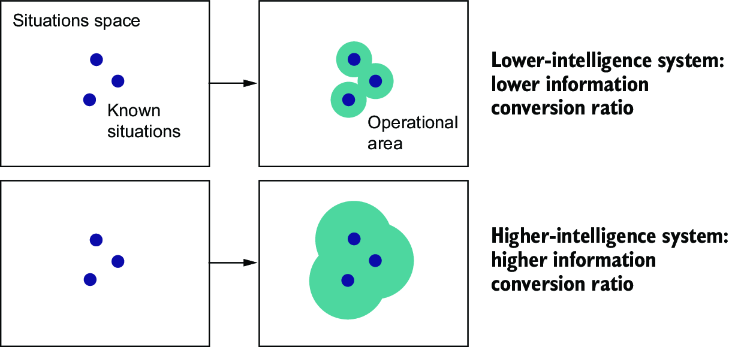
Compare local generalization, which handles modest variation around familiar inputs, with extreme generalization, which addresses novel situations. section 19.2.2


















