Suppose a sustainability team spends six hours drafting each report topic. AI could reduce that effort, but the reporting process still requires coordination with compliance, HR, and finance. The useful question is not simply what can be automated; it is which task will create the most value when people spend less time on it. section 10.1.1
Automation is a design choice about how much work and decision-making an AI system takes on. Assisted intelligence supports a person's decisions; augmented intelligence contributes suggestions and plays a more active role; autonomous intelligence makes decisions and takes actions with minimal human intervention. These are gradual levels, not a mandate to remove people from every workflow. section 3.3.2
Choose the degree of automation task by task:
- Assess value: measure manual effort, then ask what higher-value work users could do instead. Accuracy and consistency may matter alongside time saved. section 10.1.1
- Check feasibility and desirability before choosing an MVP task; prioritize a small part of the user journey rather than promising to automate it all. section 10.1.1
- Keep judgment where it improves the result. Routing routine customer requests can suit full automation; deciding which product features to build calls for human and stakeholder input. section 3.3.2
- Make the division of labor visible in the user experience, whether the interface is conversational, graphical, or hybrid. section 3.3 section 3.4
Make the benefit concrete
A predictive analytics platform reduces data aggregation from two hours to ten minutes per planner each week. Across ten planners, that is about 18.33 hours saved weekly. At $50 per hour, the estimated employee-time saving is $916.50 per week. Pair the calculation with what planners can now focus on: strategic decisions. section 12.3.1
Agentic AI extends automation to multistep workflows using tools, including predictive and generative models. Large-scale automation is a longer-term opportunity, not a reason to assume today's agent limitations have been solved. section 3.4 section 9.4
Figure 10.3 Look for automation potentials at the intersection of objective value, feasibility, and subjective desirability.
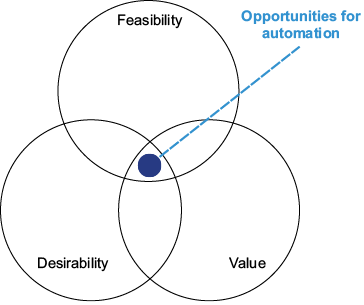
Use the value–feasibility–desirability intersection to compare candidate tasks before committing to automation. section 10.1.1


















