Automation executes delivery and testing processes through software, reducing manual intervention while creating repeatable evidence, confidence, and accountability for machine-learning systems. section 8.2 section 1.3
Apply automation at two delivery checkpoints:
- Testing: implement a test environment, generate testing data without leaks, measure functional performance, and test nonfunctional features through agile, reproducible procedures. section 8.2
- Production promotion: automate CI/CD movement of all files, execute post-release tests, verify results, and prepare authorized intervention for deployment failures. section 9.8
- Documentation and governance: preserve systematic evidence that supports production engineering, operations, users, stakeholders, and regulators. section 8.2
A sprint-ready automation plan
Create ticket S2.4 for the test environment and data-leak controls, S2.5 for functional tests and measurements, and S2.6 for nonfunctional tests. Build the CI/CD promotion process with a standard pipeline tool such as Jenkins, attach an automated post-release test plan, then run and verify the results during release. section 8.2 section 9.8
Figure 1.3 A generic DevOps production and delivery process (modeled after Ebert, 2016; redrawn and amended by the author)
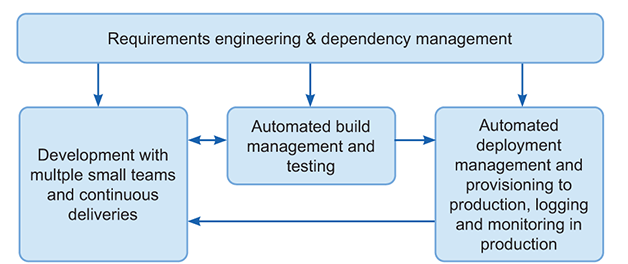
Use the generic DevOps production and delivery process to locate automation across development, delivery, and operational handoffs. section 1.3


















