liveBook · Manning

Backpropagation

As explained in Applied Reinforcement Learning

Backpropagation computes gradients of a model loss with respect to parameters by applying the chain rule backward through a computational graph.

Backpropagation sends a loss signal backward through a neural network to estimate how much each weight and bias contributed to an error. In deep Q-learning, the loss compares predictions with targets built from rewards and bootstrapped value estimates. section 8.2 section 8.6

Applying the chain rule through the network’s sequence of transformations gives each parameter a gradient indicating the direction and magnitude of change that can reduce future error. section 8.2

Figure 8.4 End-to-end learning in deep neural networks
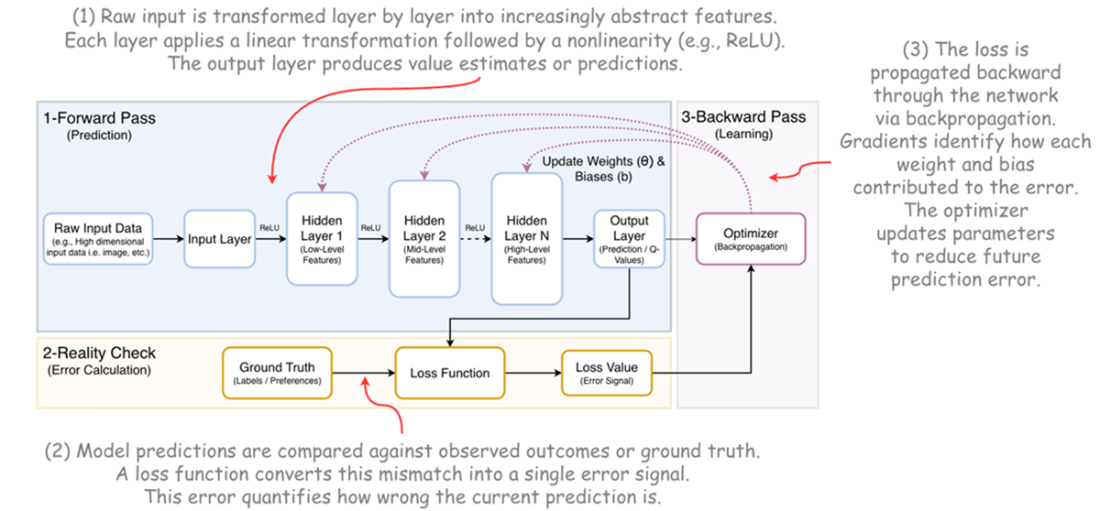
Trace the end-to-end learning loop from prediction and loss to the backward pass. section 8.2


How Applied Reinforcement Learning covers it

How deep it goes
Explains chain-rule gradient flow through layers and parameter contributions, without implementation steps.
Examples
Illustrates gradients through layers of linear transformations and nonlinearities, using reinforcement-learning targets built from experience.
What you can do after
Understand how loss signals assign corrective gradients to weights and biases across network layers.
How it connects
Connects neural networks, loss functions, the chain rule, and deep Q-learning.

Also explained in

Compare how 25 books explain backpropagation →

Related concepts

This explainer was generated by Manning's knowledge graph from the text of Applied Reinforcement Learning. The section links point to the parts of the book it draws on.






















