Backpropagation trains neural networks by computing how much each parameter contributes to a loss, then using those gradients to update the parameters. It follows a forward pass, loss calculation, backward propagation through the chain rule, and parameter update. section 4.1.1
A typical training iteration proceeds as follows:
- Initialize the network weights. section 4.1.1
- Run input data forward to produce predictions. section 4.1.1 section 8.2.2
- Compare predictions with labels using a loss function such as binary cross-entropy. section 4.1.1 section 7.2.2
- Propagate loss derivatives backward through the network, using the chain rule to calculate gradients for hidden layers and parameters. section 4.1.1
- Use an optimizer to adjust parameters in the direction that reduces loss. section 4.1.1 section 8.2.2
PyTorch fake-voice training loop
A training loop clears existing gradients, performs a forward pass, computes the criterion, calls `loss.backward()`, and runs `optimizer.step()`. Validation performs the forward pass and loss calculation without backpropagating the error. section 8.2.2
Figure 4.6 Steps in the training of a deep learning model using gradient descent.
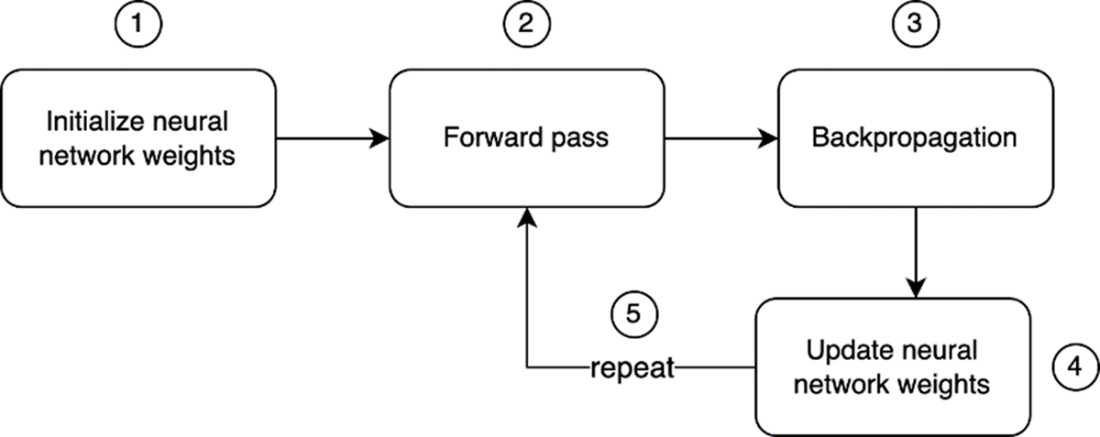
Use the training diagram to connect initialization, forward prediction, loss calculation, backpropagation, and parameter updates. section 4.1.1
























