Suppose waiting times seem to fall into short and long groups. Clustering describes those groups without requiring a group label for every observation. In a mixture model, each cluster has a center, a width, and a weight describing how prevalent it is. section 8.8
Group membership need not be an all-or-nothing decision. For a particular waiting time, evaluate how well it fits each cluster, multiply by that cluster’s mixture weight, and normalize across clusters. The result is a membership probability that can express uncertainty near the boundary. section 8.8
Choosing how many groups to allow
A two-cluster model separates short and long Old Faithful waiting times, but fixing the wrong number of clusters could split one group unnecessarily or merge distinct groups. A stick-breaking model instead generates mixture weights for additional components. In a practical ten-component version, two components receive substantial posterior weight and the others receive negligible weight; ten is an upper limit, not a claim that ten groups exist. section 8.9 section 8.10
Check the fitted model as well as its group assignments. A posterior predictive check compares simulated observations with the data. If trace plots show cluster parameters repeatedly swapping roles, label switching may be responsible: symmetric components have no inherent order. Ordering their centers can make the labels consistent across posterior draws. section 8.8 section 8.7
Figure 8.7 Top: the observed data. Bottom: the probability that a given datapoint belongs to either cluster. The cluster membership probabilities reflect the trend in the observe data.
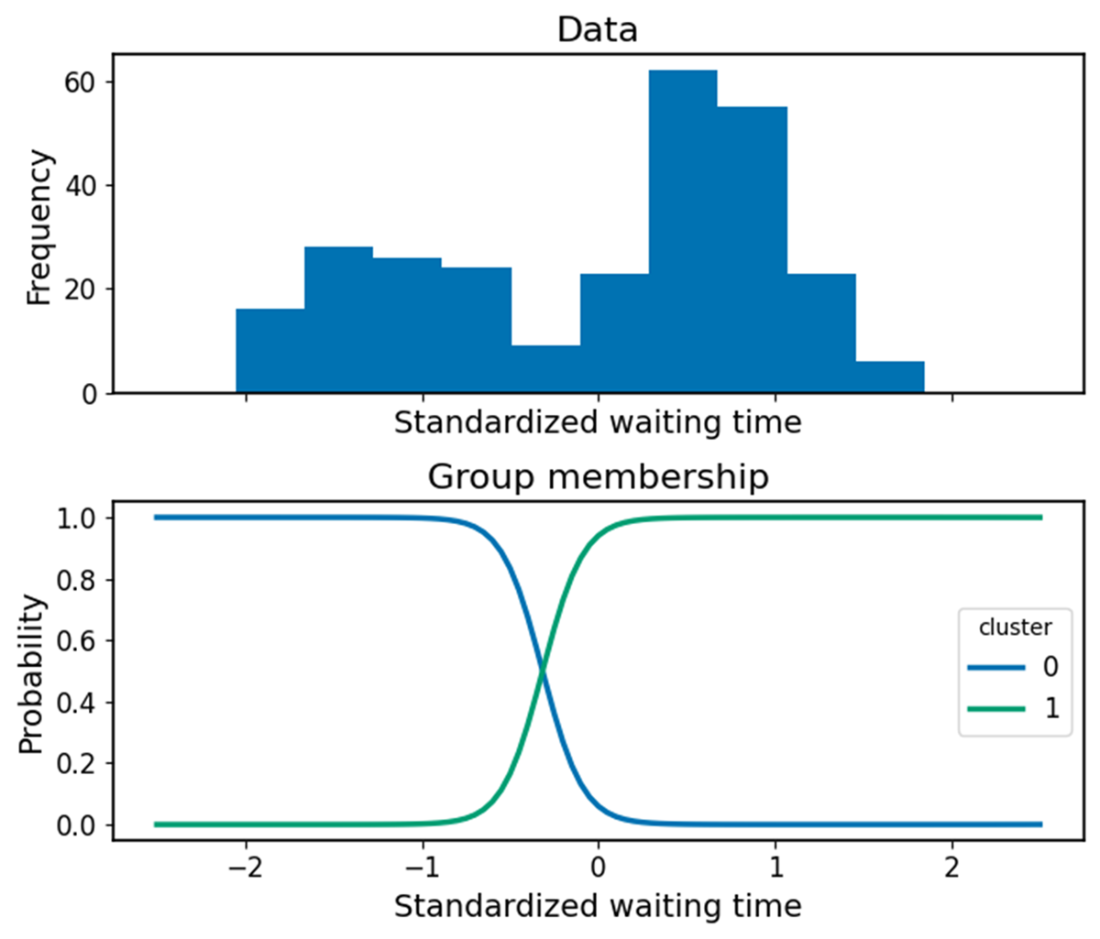
Compare the observed waiting times with the plotted probabilities of belonging to either cluster; the probabilities show how group membership changes across the data range. section 8.8
The same approach can group customers by recency, frequency, and monetary behavior for analysis and targeting. Other cited uses include identifying bimodal gene expression and studying household consumption classes. section 8.11























