A context window is the maximum token count an embedding model can process in one forward pass. Inputs beyond that limit may be ignored, so long documents must be handled within the model’s supported window. section 6.3 section 6.3.1
For embedding models, context-window limits create three practical constraints:
- Nomic Embed Text supports up to 8,192 tokens, roughly 6,000–7,000 English words depending on vocabulary and tokenization. section 6.3.1
- Transformer self-attention compares every token with every other token, giving processing costs that grow quadratically with sequence length. section 6.3.1
- Increasing the limit is not merely expensive: embeddings must compress more diverse information into the same fixed-size vector. section 6.3.2
Scaling the window
At 8,192 tokens, attention requires roughly 67 million computations. Doubling the window to 16,384 tokens raises that figure to approximately 268 million; 32,768 tokens exceeds one billion. At dataset scale, the resulting GPU requirements and processing costs make routine long-document embedding impractical. section 6.3.1 section 6.3.2
Figure 6.3 Computational Cost of Context Window Expansion
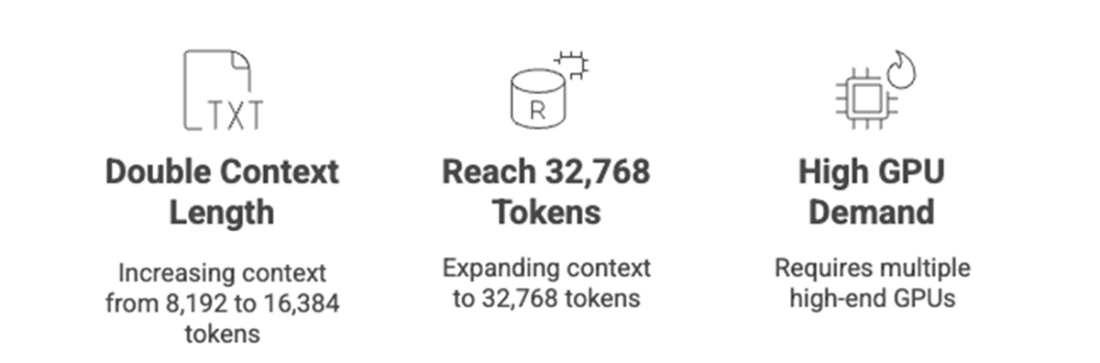
Use the computational-cost figure to compare how attention operations escalate as the context window expands. section 6.3.2