A deployment pipeline automates the path from source changes to production. Continuous integration (CI) combines frequent code integration with automated builds and tests; continuous delivery (CD) carries changes toward production safely and predictably. section 12.1
In an Anthos workflow, the pipeline connects:
- Developers, who write code, preview changes, and commit to the repository. section 12.0
- CI, which runs code reviews, tests, and container image builds after a commit. section 12.0
- Operators, who configure Kubernetes deployments for development, test, and production environments. section 12.0
- CD, which promotes releases through defined target environments. section 12.5
With Cloud Deploy, delivery-pipeline manifests specify promotion order, while target definitions identify clusters. Skaffold renders and deploys Kubernetes manifests. A release starts a rollout at the first target; promotion can advance it, and targets can require manual approval. section 12.5.2
A test-to-staging-to-production sequence can be configured with separate target files. Before creating a release, have the environment clusters deployed and the CI-generated container image and Kubernetes manifest ready. section 12.5.2
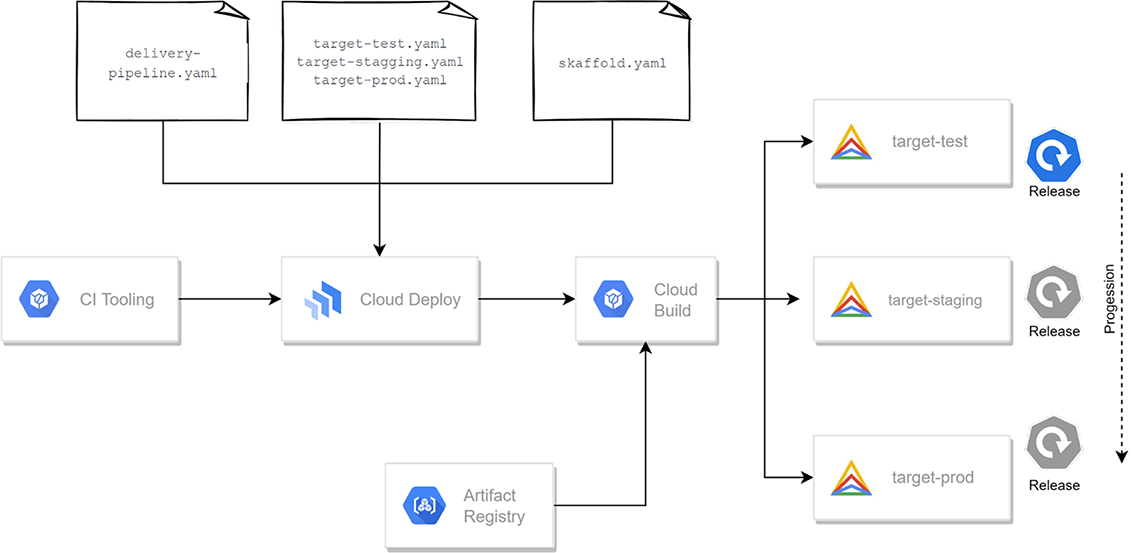
Use the workflow diagram to follow how Cloud Deploy connects pipeline configuration, targets, and deployment. section 12.5.2





























