A deployment pipeline is an automated sequence that builds, tests, reviews, deploys, and releases infrastructure changes. It codifies the release process so teams apply changes consistently and reproducibly rather than relying on memory. section 7.1.1
A typical infrastructure pipeline moves through these stages:
- Check configuration conflicts and syntax problems. section 7.1.1
- Run unit tests for formatting and standards. section 7.1.1
- Deploy to a testing environment and run integration and end-to-end tests. section 7.1.2
- Pause for peer or organizational approval when a quality gate is required. section 7.0
- Deploy or release the validated change to production. section 7.1.1
Continuous integration starts the workflow whenever a team member merges changes, helping identify conflicts early. Continuous delivery extends it by deploying to a test environment, running broader tests, and optionally waiting for manual approval before production. section 7.1.1 section 7.1.2
Pipelines also deliver infrastructure modules: test the module, review the results, then release a new version instead of deploying directly to production. Emergency fixes may use continuous deployment or an isolated branch. section 7.1.5
Treat pipeline credentials and sensitive variables as security boundaries. Use secrets managers, avoid administrative credentials where possible, and prevent passwords from appearing in logs. Stateful changes need idempotent migration steps that run alongside deployment and testing. section 8.1 section 9.3.2
Testing and releasing a service
A GitHub Actions pipeline for a service can run unit tests, deploy infrastructure to a testing environment, run integration and end-to-end tests, wait for approval, and deploy to Google Cloud Run. section 7.1.2
Figure 7.4 Continuous delivery automatically deploys and runs infrastructure changes in a testing environment and waits for manual approval for production.
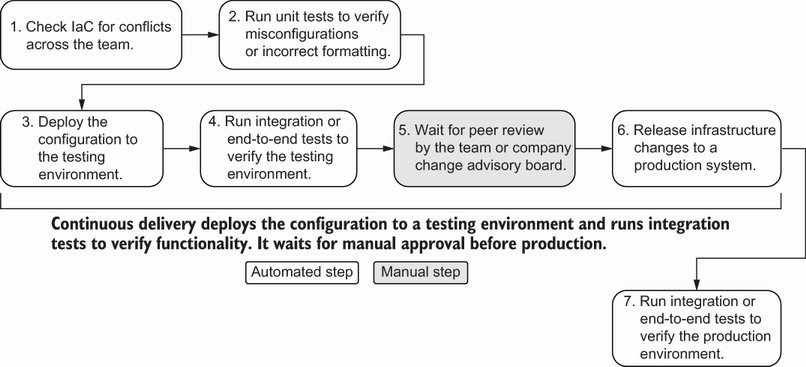
Use the workflow figure to follow automated testing, testing-environment deployment, manual approval, and production release. section 7.1.2





























