A graph models relationships as vertices and edges: G = (V, E), where V contains distinct entities and E connects a source vertex to a destination vertex. Unlike a drawing, an abstract graph does not require geometric placement. section 14.1 section 15.1.1
Choose the graph variant that matches the relationships being modeled:
- Use a simple graph when loops and multiple edges between the same pair of vertices are disallowed. section 14.1
- Use directed edges when travel or influence has a source-to-destination direction; represent a two-way relationship with two directed edges. section 14.1 section 14.3.1
- Use a weighted graph, also called a network, when each edge carries a numeric cost such as distance. section 14.1
- Represent the structure programmatically with vertex and edge objects plus an adjacency list mapping each vertex to its outgoing edges. section 14.1.3
Finding a delivery route
Map each road intersection to a vertex and each permitted road movement to a directed edge. With equal-sized blocks, route length can be measured by counting traversed blocks; one-way streets create detours. This model supports searching for minimum-distance routes, including Dijkstra’s and A* algorithms. section 14.3.1 section 14.0
Listing 14.1 The Graph class
class Vertex
  #type string
  label

class Edge
  #type Vertex
  source
  #type Vertex
  dest
  #type double
  weight
  #type string
  label

class Graph
  #type List[Vertices]
  vertices
  #type HashTable[Vertex->List[Edge]]
  adjacencyList

  function Graph()
    adjacencyList ← new HashTable()

  function addVertex(v)
    throw-if v in vertices
    vertices.insert(v)                                     #1
    adjacencyList[v] ← []                                  #2

  function addEdge(v, u, weight=0, label=””)
    throw-if not (v in vertices and u in vertices)
    if areAdjacent(v, u) then                              #3
      removeEdge(v, u)                                     #4
    adjacencyList[v].insert(new Edge(v, u, weight, label)) #5

  function areAdjacent(v, u)
    throw-if not (v in vertices and u in vertices)
    for e in adjacencyList[v] do                           #6
      if e.dest == u then                                  #7
        return true
    return false
Inspect the Graph class pseudocode to see vertices, weighted labeled edges, adjacency lists, and basic validation operations assembled into an implementation. section 14.1.3
Figure 14.10 Building a graph on the map in figure 14.8. We added a vertex to each road intersection (some vertices are, however, omitted for better readability) and edges connect adjacent intersections connected by a one-way street (two-way streets are modeled with a couple of edges).
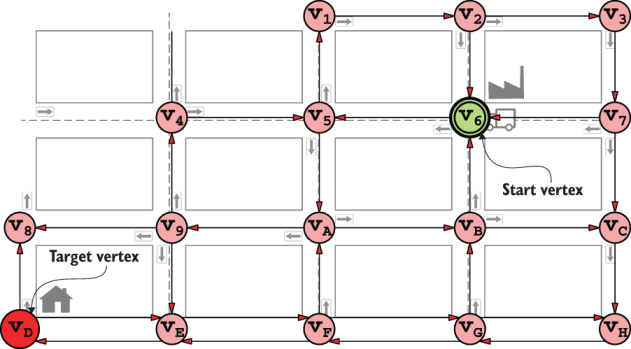
Follow the translation from a street map to a directed graph, including vertices at intersections and edges for one-way or two-way streets. section 14.3.1
A graph can also be drawn, but the drawing adds placement and intersection constraints. A planar graph is one that has a planar embedding; not every abstract graph is planar. section 15.1.1




















