A hallucination is a model-generated statement or content that is factually incorrect or nonsensical while appearing coherent. LLMs can produce hallucinations when confidently generating information not explicitly learned or responding to out-of-distribution prompts, making validation important in critical applications. section 1.3
LLMs predict likely next tokens from training data rather than retrieving documents from a current, verified knowledge base. They can therefore produce plausible but outdated, inaccurate, or fictional details. Retrieval-augmented generation reduces this risk by retrieving relevant information with encoder models before decoder models generate a grounded response. section 5.3.1
A fabricated answer about Mars
Prompt: “Who was the first person to walk on Mars?” Response: “John Smith was the first person to walk on Mars in 2025.” The answer is coherent but fabricated because no human has walked on Mars. section 5.5
Figure 5.16 A great example of a hallucinated response generated by ChatGPT 4.0. It generated a factually incorrect response to the questions about Traversaal.ai – given it was founded in June 2023, by me 😊
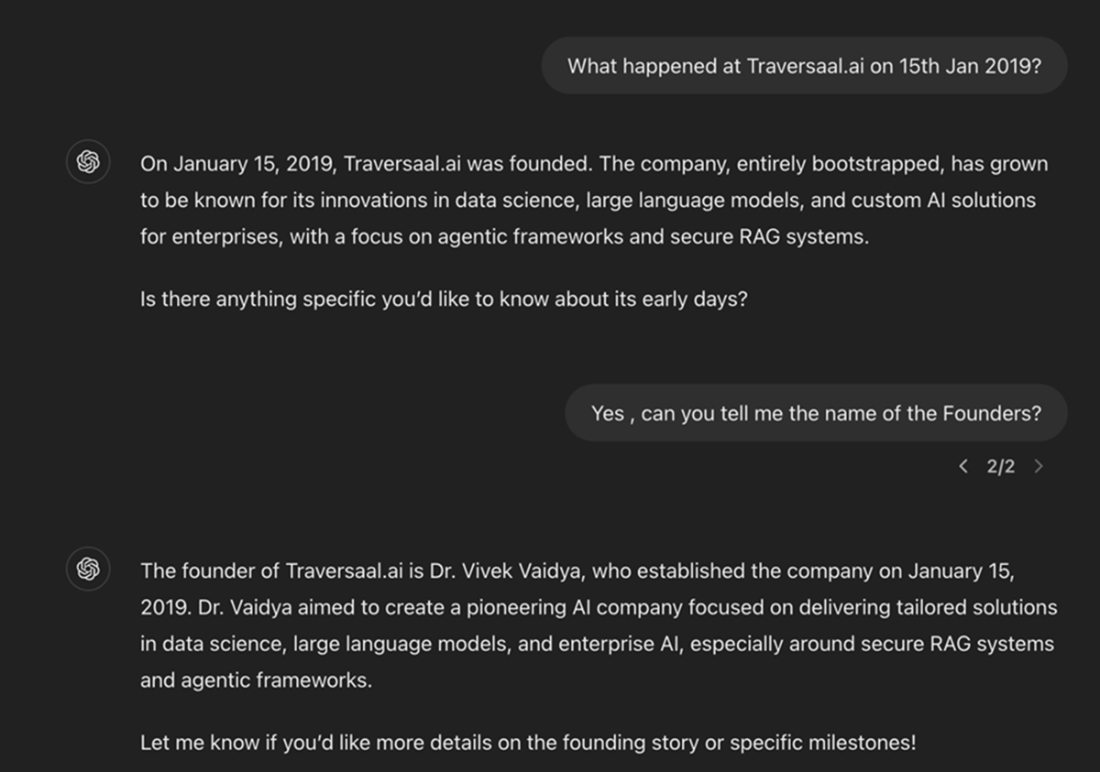
Use the figure as a concrete visual example of a decoder producing a factually incorrect response about an organization. section 5.5