A hallucination is a claim generated by an AI system that is unsupported by verifiable evidence or fabricated. It can sound fluent and confident, making the failure easy to miss. Models can learn the form of a convincing answer before they acquire its factual grounding. section 1.1.3 section 1.5
A fabricated study
An assistant asked about the “2023 Stanford Marshmallow Experiment on AI Ethics” might invent a summary, methodology, findings, and a researcher’s name. The details may sound plausible, but the study does not exist. section 1.1.3
Detection turns a free-form answer into individual claims, then checks each claim against evidence. A simple faithfulness measure is the number of supported claims divided by the total number of claims. Extracting implicit claims and deciding what counts as support require judgment, so the ratio depends on those choices. section 1.1.3 section 1.5
Figure 5.1 A flow chart for choosing a hallucination detection strategy. Closed-domain tasks can use grounding based on sources to verify claims. Open-domain tasks require self-consistency checks, or rely on external fact retrieval, or other factual alignment signals.
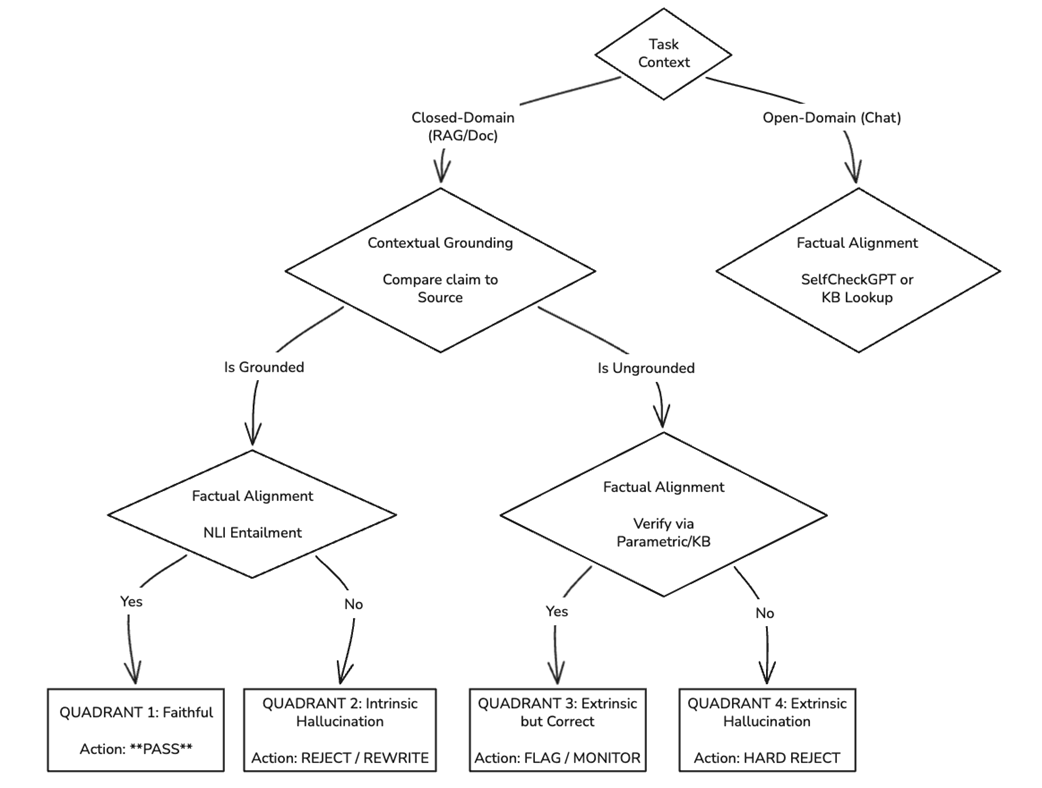
Choose a detection strategy based on whether a supplied source defines the allowable answer. section 5.1
Use evidence suited to the task:
- Closed-domain: check whether claims are grounded in the supplied document or retrieved context. section 5.1
- Open-domain: without a supplied grounding source, use signals such as external fact retrieval or self-consistency checks. section 5.1
Factuality here means support from verifiable evidence, rather than a judgment about an abstract or subjective notion of truth. Detection identifies unsupported claims; it does not by itself explain their cause or prevent them. section 5.1 section 5.4.5
Mitigation can operate at several levels:
- Prompt engineering can instruct a model to use supplied documents or admit uncertainty, but models may ignore instructions. section 5.4.5
- Retrieval-augmented generation supplies relevant context, but poor retrieval or claims beyond the retrieved documents can still produce hallucinations. section 5.4.5
- Fine-tuning on verified data, reinforcement learning from human feedback with factuality rewards, and constitutional AI can encourage more faithful behavior. section 5.4.5
No mitigation eliminates hallucination. Continue detection and monitoring to see whether the chosen measures work and to catch failures before they erode user trust or cause deployment problems. section 5.4.5 section 1.0




































