An outlier is an observation unusually distant from the others. In aqueous-solubility data, extreme logS values can indicate compounds with unusual physicochemical properties that may not occur in production and can hinder model learning. section 4.1.2
Ways to identify or account for unusual observations include:
- Use the interquartile range (IQR): flag values below Q1 − 1.5 × IQR or above Q3 + 1.5 × IQR. section 4.1.2
- Inspect extreme compounds using chemical knowledge; a wide solubility range may signal unusual structures. section 4.1.2
- For robust model fitting in the presence of outliers, RANSAC is one available method. section 4.5
Figure 4.2 The least soluble molecules (top row) and the most soluble molecules (bottom row) in the training data set.
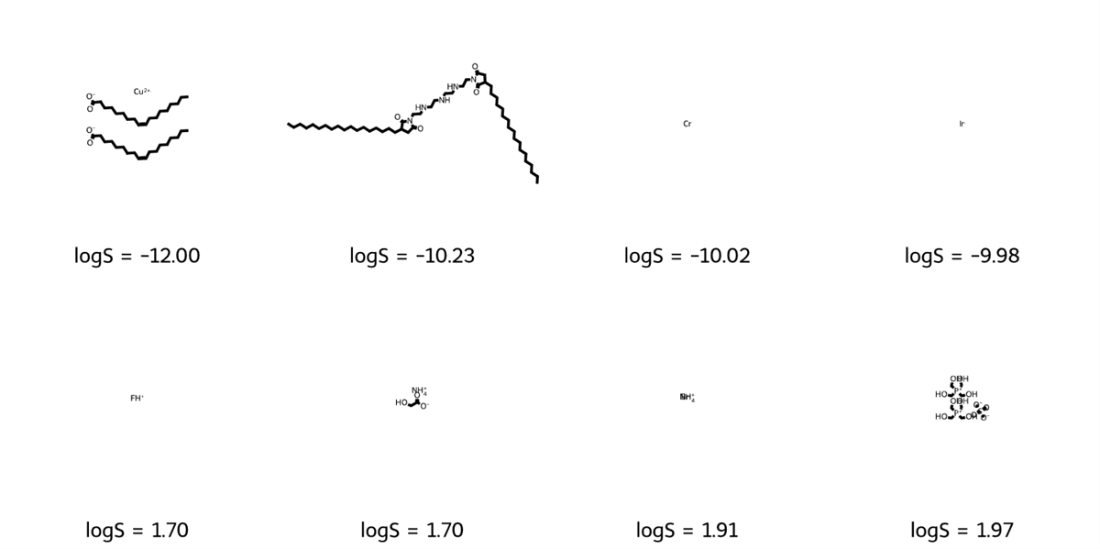
Compare the least and most soluble training-set molecules when inspecting chemical extremes. section 4.1.2
Anomaly detection can also use density estimation: observations mapping to low-probability regions are possible outliers. section 7.0