A latent space is an internal numerical space that represents data through learned features. Rather than retaining every detail of an input, a compact representation can capture patterns useful for reconstructing it. Similar inputs may cluster together, revealing relationships not explicitly labeled in the data. section 3.4.5
An autoencoder learns such a representation through a bottleneck. Its encoder compresses an input into a latent code, and its decoder uses that code to reconstruct the input. The constraint encourages the network to retain informative features, much as a short description of a chair emphasizes recognizable characteristics rather than every detail. section 3.4.5
Figure 3.16 An autoencoder compresses input into a compact internal code and then reconstructs it. The encoder reduces the data to a low-dimensional representation in the bottleneck, where only the most informative patterns remain. The decoder expands this representation back into the original space, producing an output that resembles the input. By learning to rebuild the data from such a constrained description, the network discovers the underlying structure that defines the input instead of its incidental details.
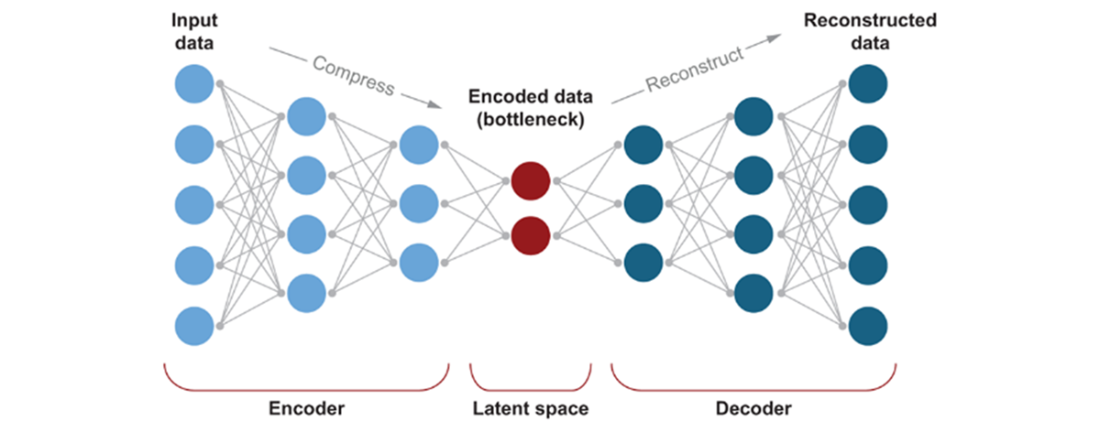
The diagram shows how an encoder compresses an input into a latent code and a decoder reconstructs it. section 3.4.5
Latent spaces can also support generation. Variational autoencoders encourage a smooth, continuous space in which nearby points correspond to similar outputs, so exploring the space can produce new samples. This smoothness is an objective of the architecture, not a guarantee that every learned representation behaves that way. section 3.4.6
Compact representations can help remove noise, identify unusual patterns, and reduce data to fewer dimensions. Their usefulness depends on what the network learns to retain: a reconstruction objective encourages informative features, but a latent code is not itself a set of human-provided labels. section 3.4.5