liveBook · Manning

Trajectory

As explained in Google Anthos in Action

A rollout is the controlled deployment of a new application or service version and its progression toward the intended state.

A rollout advances an application deployment through defined target environments. In Google Cloud Deploy, creating a release creates a rollout for the first target; promotion creates a rollout for the next target. section 12.5.2

A typical Cloud Deploy progression works as follows:

  • Define a delivery pipeline with ordered targets, such as test, staging, and production. section 12.5.2
  • Create a release from CI or the command line; Cloud Deploy deploys it to the first target. section 12.5.2
  • Promote the release to advance it, and configure targets to require manual approval when needed. section 12.5.2
  • Approve or reject a rollout when its target requires approval. section 12.5.2

Test to production

A pipeline can deploy a release to test, promote it to staging, then promote it to production. Target definitions can require approval for promotions. section 12.5.2
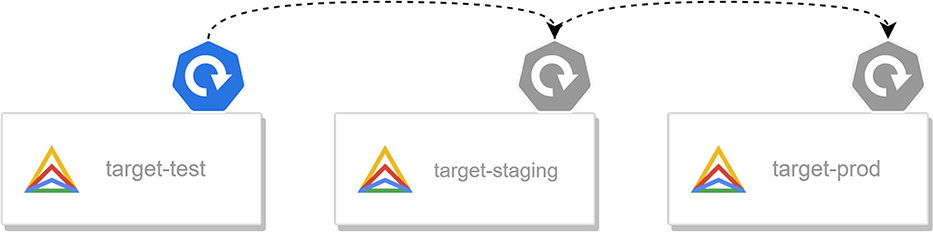
Figure 12.39 Promotion sequence
12-39

The promotion sequence diagram illustrates progression across deployment targets. section 12.5.2

Rollouts are also named as a platform primitive in Knative, which provides serverless workload capabilities on Kubernetes. section 9.2.1


How Google Anthos in Action covers it

How deep it goes
Details release creation, target promotion, and approval or rejection, without explaining rollout internals.
Examples
Uses a test-to-staging-to-production pipeline with optional manual promotion approvals.
What it assumes
Assumes a container image, Kubernetes manifest, and configured pipeline targets; CI can generate the deployment artifacts.
What you can do after
Operate Google Cloud Deploy to create releases, promote rollouts, and approve or reject gated deployments.
How it connects
Connects rollouts with continuous delivery, Kubernetes, Knative, Skaffold, releases, and deployment targets.

Also explained in

Compare how 19 books explain trajectory →

Related concepts

This explainer was generated by Manning's knowledge graph from the text of Google Anthos in Action. The section links point to the parts of the book it draws on.
















