liveBook · Manning

Trajectory

As explained in Graph Neural Networks in Action

A time-ordered sequence of positions or states describing the evolution of an entity.

A trajectory records an entity’s evolution over time. For sensor nodes, it can track position—and velocity—across frames. Modeling these sequences helps predict future body motion from recent observations. section 6.0 section 6.2.1

In an NRI model, future trajectory prediction follows this pipeline:

  • Encode node data into probabilities for different edge types. section 6.5.3
  • Use a recurrent decoder, conditioned on those probabilities and previous timesteps, to predict future node trajectories. section 6.4.3 section 6.5.3
  • Train using reconstruction loss and KL divergence; evaluate predictions over multiple future horizons. section 6.4.3
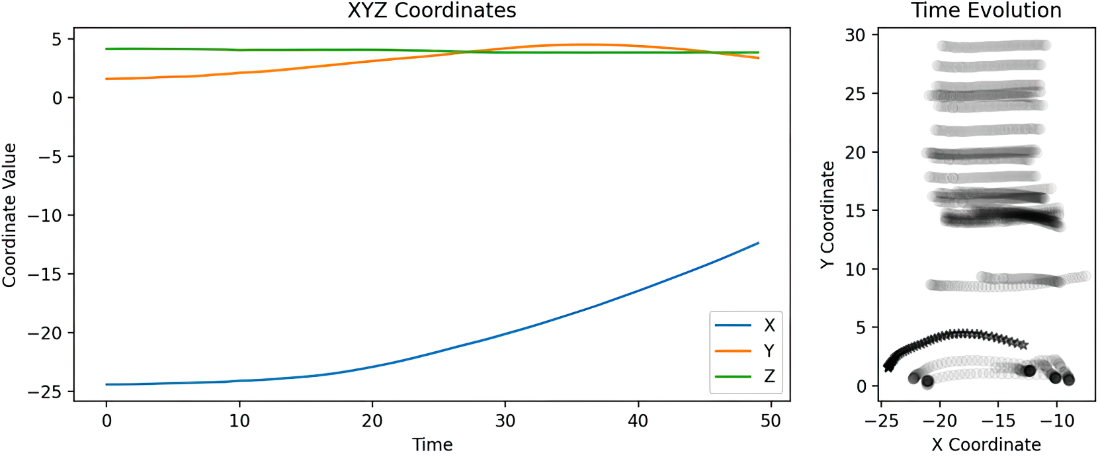
Figure 6.3 Preconstructed spatial trajectories of sensors
figure

See sensor paths plotted in space, including a foot sensor’s movement across dimensions. section 6.2.1


How Graph Neural Networks in Action covers it

How deep it goes
Traces NRI encoding, recurrent decoding, training losses, and future-horizon evaluation without deriving the model mathematically.
Examples
Tracks a walking body’s sensor positions and velocities, then predicts node motion across future timesteps.
What you can do after
Predict future node trajectories by conditioning a recurrent decoder on inferred edge-type probabilities.
How it connects
Connects trajectories to dynamic graphs, spatiotemporal graph neural networks, pose estimation, recurrent neural networks, and autoencoders.

Also explained in

Compare how 19 books explain trajectory →

Related concepts

This explainer was generated by Manning's knowledge graph from the text of Graph Neural Networks in Action. The section links point to the parts of the book it draws on.
















