Classification identifies packets or traffic and sorts them into classes according to the treatment they should receive. During congestion, those classes support differentiated queuing and scheduling instead of default FIFO forwarding. section 10.2.3 section 10.3
Classify traffic using several increasingly detailed signals:
- Use ACLs to match Layer 3 and Layer 4 header information; permitted traffic can be assigned to different classes. section 10.3.1
- Use Network-Based Application Recognition (NBAR) for deep packet inspection when header information cannot identify the application accurately. section 10.3.1
- Use existing DSCP or PCP markings to classify packets without repeatedly inspecting addresses, ports, or payload contents. section 10.3.2
Typical classes include Real-Time traffic such as voice and video, Business Critical applications, Default traffic, and Scavenger traffic. Scavenger traffic receives low priority and may be delayed or dropped first during congestion. section 10.3.1
Classifying a packet through the network
An early device can inspect a packet with an ACL or NBAR, assign its class, and mark it. Later devices can classify it from the DSCP or PCP value, reducing processing and configuration effort. PCP is available only in 802.1Q-tagged frames, while DSCP resides in IPv4 and IPv6 headers. section 10.3.2 section 10.7
Figure 10.7 The QoS big picture. A router receives packets and makes a forwarding decision for each, classifies the packets based on their type, queues them for transmission, and uses scheduling methods to determine the order of transmission.
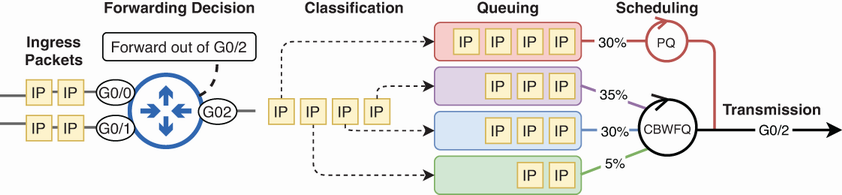
Trace the QoS flow from packet reception and forwarding decisions through classification, queuing, and transmission scheduling. section 10.2.3
Figure 10.8 After making a forwarding decision, the device classifies each packet into a class: Real-Time (i.e., voice and video), Business Critical (important business apps), Default, and Scavenger traffic (low priority).
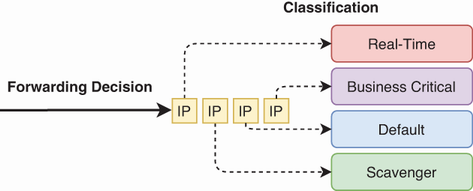
Compare Real-Time, Business Critical, Default, and Scavenger classes in a packet-classification overview. section 10.3.1






























